Biodiversity credits: a new frontier for conservation funding
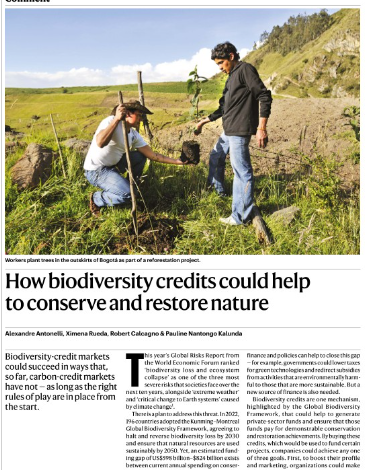
At COP16 in Cali this week, biodiversity credits are gaining attention as a promising tool to channel private-sector funding towards conservation and restoration efforts. Alexandre Antonelli’s insightful commentary in Nature outlines the potential of this innovative mechanism, which has the ability to ensure that financial investments lead to real, measurable impacts on biodiversity. I recently had the privilege of joining Antonelli on a field trip through Brazil’s Atlantic Forest, one of the world’s richest biodiversity hotspots, and witnessed firsthand the importance of robust conservation initiatives.
As Antonelli points out, “Mandatory biodiversity-credit markets—where companies impacting the environment are required by law to purchase credits—are emerging in several countries, including Colombia, Germany, India, France, and England.” However, lessons from carbon-credit markets reveal critical challenges; biodiversity-credit markets must be carefully structured to truly drive conservation and avoid pitfalls.
An International Advisory Panel on Biodiversity Credits has outlined six essential criteria to build effective and credible biodiversity-credit markets. These principles ensure transparency, accountability, and meaningful outcomes for conservation efforts. Here’s a summary:
- Clear Goals: Projects must define specific conservation or restoration objectives from the outset, considering both the goals of indigenous communities and those purchasing the credits.
- Scientific Rigor: Measurements of biodiversity gains should be scientifically sound and relevant to each ecosystem.
- Independent Verification: Measurements need to be confirmed by independent parties to ensure credibility.
- Transparency: All data related to biodiversity gains should be accessible to the public.
- Continuous Monitoring: Biodiversity should be measured at all stages—before, during, and after the project.
- Demonstrable Impact: Projects must show that their efforts directly lead to increased biodiversity conservation or restoration.
These criteria will help biodiversity credits become a trusted means of funding conservation efforts. Bold experimentation and early investment are still needed to propel this market forward, and I urge my peers in philanthropy to provide the seed funding to kick-start such projects. At Good Energies Foundation, we’re eager to collaborate and share insights with pioneers like Terrasos in Colombia, Belterra Agroforestry in Brazil, and NatureFinance globally.
Kudos to Alexandre Antonelli, Ximena Rueda, Robert Calcagno, and Pauline Nantongo for their leadership in making the case for biodiversity-credit markets. The more we invest in nature today, the greater the benefits for future generations.
source :
Temukan peta dengan kualitas terbaik untuk gambar peta indonesia lengkap dengan provinsi.