The carbon cost of transportation choices
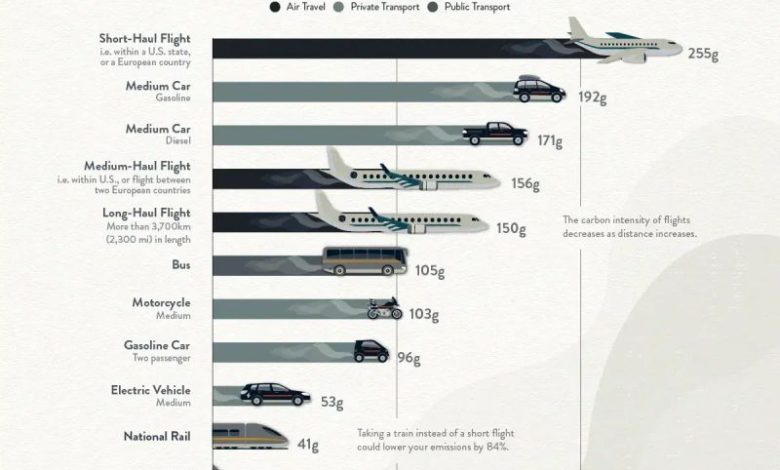
This eye-opening infographic from Visual Capitalist, titled “The Carbon Cost of Transportation,” does more than just compare CO₂ emissions across different travel methods—it challenges us to rethink the environmental impact of our daily transportation decisions.
Breaking Down the Numbers: The Carbon Hierarchy
The carbon footprint of each mode of transportation is measured in grams of CO₂ equivalents per passenger-kilometer. Here’s how the options stack up:
High Emissions: Air Travel
- Short-Haul Flights – At 255g CO₂ per passenger-kilometer, these are the most carbon-intensive travel method, often for trips within a single U.S. state or European country.
- Medium-Haul Flights – Coming in at 156g CO₂, this includes flights across larger distances within a country or between nearby countries.
- Long-Haul Flights – These flights, covering over 3,700 km, emit around 150g CO₂ per passenger-kilometer, becoming slightly more efficient over longer distances.
Moderate Emissions: Private Transport
- Medium Car (Gasoline) – At 192g CO₂, this is one of the higher-emission ground options.
- Medium Car (Diesel) – Slightly lower at 171g CO₂ per passenger-kilometer.
- Motorcycle – With emissions of 103g CO₂, motorcycles are less impactful than cars but still significant.
- Carpooling in a Gasoline Car – Two passengers reduce the footprint to 96g CO₂, showing that shared rides help lower individual carbon output.
- Electric Vehicle (EV) – Averaging 53g CO₂, EVs shine as a lower-emission choice, which only improves as power grids rely more on renewables.
Lower Emissions: Public and Rail Transport
- Bus – At 105g CO₂, buses offer an efficient way to transport more people at a reduced per-passenger footprint.
- National Rail – With emissions of 41g CO₂, trains prove to be one of the greenest choices.
- Ferry (Foot Passengers) – Coming in at 19g CO₂, ferries for pedestrians show that water transport can also be eco-friendly.
Ultra-Low Emissions: International Rail
Eurostar – At a remarkable 6g CO₂, international trains like the Eurostar represent the lowest carbon impact on this list, highlighting rail travel as the most sustainable long-distance option.
Takeaways and Reflections
- Rethinking Flights: Short-haul flights emit up to 84% more CO₂ per passenger-kilometer than trains. Opting for rail instead of short flights for regional trips could significantly reduce personal and collective carbon footprints.
- Power of Public Transport: Buses, ferries, and trains offer lower-carbon alternatives to private cars. By moving away from individual car use, especially fossil-fueled cars, we can reduce traffic emissions and work towards cleaner cities.
- Electric Vehicles and the Future: As electric grids shift to renewable energy, EVs will continue to stand out as a greener alternative to traditional cars. Their current 53g CO₂ per passenger-kilometer footprint highlights the immediate impact they can have in reducing emissions.
The real takeaway here is that we can choose the impact we have on our environment. With each choice, from local errands to long-distance trips, there’s an opportunity to lower our carbon footprint. Whether by swapping short flights for trains, carpooling, or embracing public transit, each decision moves us closer to a sustainable future.
What choices will you make to cut your carbon cost of transportation? Let’s create a travel landscape that prioritizes sustainability, one trip at a time.
source :
Temukan peta dengan kualitas terbaik untuk gambar peta indonesia lengkap dengan provinsi.