A 9-step process to build a sustainability strategy
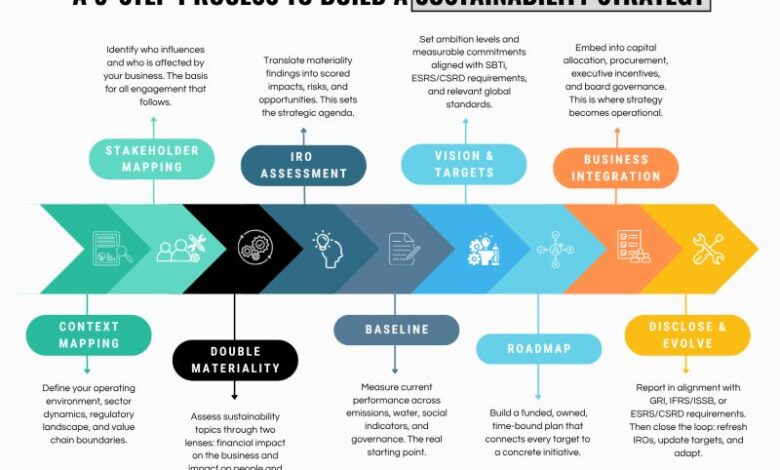
The 9-Step Blueprint for a Living Sustainability Strategy
For too long, sustainability has been treated as a glossy appendix to the annual report a “nice-to-have” fueled by investor pressure or a CEO’s sudden change of heart. But in the modern boardroom, sustainability is no longer an ornament; it is the engine.
The most resilient companies don’t just “do” sustainability; they build a system that breathes it. This is not about a single document, but a 9-step metamorphosis from a traditional business to a future-proof enterprise.
Phase 1: The Foundation of Context
Before a company can change the world, it must understand its place within it. This is the Environmental Scan. You cannot set a target in a vacuum. You must map:
- The Ecosystem: Your sector dynamics and regulatory horizon.
- The Value Chain: Where do your boundaries truly end?
- The People: The stakeholders who hold the power to accelerate or halt your progress.
Phase 2: The Filter of Materiality
Once you have the context, you need a filter. Not every global issue is your issue. This is where the IRO Assessment (Impact, Risk, and Opportunity) and Double Materiality come into play.
- Inside-Out: How does your business impact the planet and society?
- Outside-In: How do climate and social shifts threaten your bottom line?
The goal is to move from “vague themes” to “vital priorities.”
Phase 3: The Architecture of Ambition
An assessment without an action plan is just a list of problems. To move into the driver’s seat, a strategy must become operational:
- Establish a Baseline: You cannot improve what you haven’t measured.
- Define Ambition: Are you aiming for compliance, or are you aiming for leadership?
- Set Targets: Measurable, time-bound, and science-based goals.
- The Roadmap: Connecting every priority to a specific initiative, a clear owner, a budget, and a deadline.
Phase 4: The Integration of Governance
This is where most strategies fail or fly. A strategy is only “real” when it touches the money and the power. It must be woven into:
- Capital Allocation: Does the budget reflect the green transition?
- Procurement: Are your suppliers held to your own standards?
- Executive Incentives: Is leadership’s bonus tied to carbon reduction or social impact?
Phase 5: The Feedback Loop of Disclosure
Reporting is often seen as the finish line a final compliance hurdle. In a sophisticated strategy, Reporting is the Pulse. It is a diagnostic tool that tests the quality of your data, identifies the gaps in your execution, and creates a transparent feedback loop. It forces accountability and provides the data necessary to refine your impacts and risks for the next cycle.
Strategy as a Management Process
A strong sustainability strategy is not a static PDF sitting on a server. It is a continuous management process that bridges the gap between high-level analysis and daily execution.
source:
https://www.linkedin.com/posts/antoniovizcaya_sustainability-esg-share-7458207924813930497-d3eb