
A review of current themes and future priorities
Approaches to urban governance are changing rapidly as cities struggle to adapt to the challenges of the 21st century. Climate change, migration, security, and a more fragile global economy are all driving urban change at a time when national governments continue to hesitate with a full commitment to cities and urban development (Frug & Barron, Citation2008). In many jurisdictions, financial transfers from national to subnational governments have mostly been stable or even slightly increasing (in absolute terms) over the years, but these transfers are often not proportionate to the increasing responsibilities and challenges that cities have to meet (United Cities and Local Governments, Citation2016). Resources rarely come with augmented authority for cities, meaning that even where cities are secure in budgetary terms they often have little autonomy for developing policy responses to meet these new and intractable challenges.
In fact, the issue of available budgets versus the array and scope of responsibilities undertaken by cities is just part of the story. The political and fiscal empowerment and autonomy of city institutions (Travers, Citation2015), the coordination of strategies and interventions at the subnational level (Arreortua, Citation2016; Rode, Citation2018), and the steady supply of skills necessary to deal with the complexities of urban governance (Muñoz, Amador, Llamas, Hernandez, & Sancho, Citation2017) are all examples of gateways through which national governments can boost or curtail their commitment to cities. It has also been argued that these urban governance constraints, in some contexts, may lead to exploitation and corruption (de Sousa & Moriconi, Citation2013; Transparency International, Citation2015).
Urban governance is an appealing concept because local governments—which can be briefly described as public bureaucracies and their political masters—do not exist in a vacuum. City administrations negotiate their way through the policy process while being subject to the influence of other levels of government, the need to steer or coordinate with other authorities, lobbying pressures, and democratic concerns (Mossberger & Stoker, Citation2001; Stone, Citation1989, Citation1993), just to name a few. Governance is also useful as an analytical lens because it does not require a priori assumptions about the roles of the various actors regarding goal setting, steering, and implementation (Pierre, Citation2014). Rather, it emphasizes the relationships and interactions between these actors as well as the conditions and rules that frame those relationships and interactions.
Despite its tactical usefulness as a concept, the theories and academic studies on urban governance to date have not yet established a mature and consolidated field of study (Davies, Citation2014; Lucas, Citation2017; Pierre, Citation2005, Citation2014). To some extent, this may be due to the transformations that occurred in the decades since the most prominent theories of urban governance were developed and the most involved empirical studies were conducted (e.g., Dahl, Citation1961; Galaskiewicz, Citation1985; Harvey, Citation1989; Logan & Molotch, Citation1987; McQuarrie & Marwell, Citation2009; Orum, Citation1995).Footnote1 As a consequence of these conceptual and explanatory struggles, urban governance research has been dominated by case studies or by theoretical claims with little empirical support. Certainly, well-designed and particularly longitudinal case studies make a significant contribution to the field. But as recently put by Lucas (Citation2017), there is “a growing chorus of urban politics scholars who have advocated a move away from single-case studies of particular cities and toward a more comparative approach to urban politics, policy, and governance” (p. 82). The shifts “from government to governance” and “managerialism to entrepreneurialism,” for example, have been pitched as a clear trend in the way cities are run for quite some time now (Harvey, Citation1989; Koch, Citation2013; Pierre, Citation2011; Stone, Citation1989). This is often understood as a process where the power or relevance of (local) government, civil servants, and elected politicians decreased relative to private actors like philanthropies, business associations, management consultants, and nongovernmental organizations. But did it really change that radically? Given the available evidence, can one be certain that local governments retreated or were pushed to a role of mere “network coordinators” (Stoker, Citation2011) at a global scale? Or did the current discourse accept these claims based on cases that overemphasized national or even subnational institutional changes?
Still, collecting systematic data on urban governance in order to understand broad trends at a global scale is extraordinarily difficult. However desirable such knowledge is, given the importance of cities for meeting contemporary challenges, the field is somewhat doomed to feeling its way. New methodologies are needed but, more than this, the identification of key sites of conflict and change and a greater emphasis on the Global South are necessary.
In both academic and public arenas, the dominating narrative of governance seems to evolve around political issues of unequal power, democratization, representation, and public participation. Issues linked to (multilevel) institutions of governance and state reform—and how these impact the pursuit of wider societal goals—seem to have less traction, particularly in public discourse. This could be due to the sheer complexity of these issues and/or the lack of suitable evidence to develop effective political narratives.
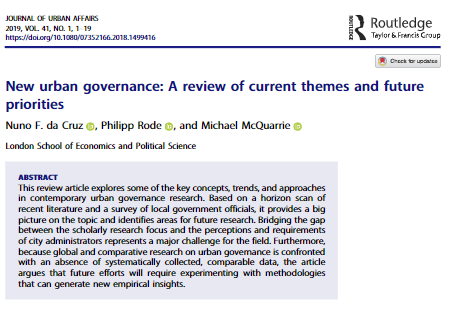
Given these practical, research, and data challenges, this review article aims to identify key areas of concern for future research on urban governance. To accomplish this, we start with a systematic review of the literature on urban governance “challenges” and a survey of city governments (LSE Cities, UN-Habitat, United Cities and Local Governments [UCLG], 2016). Following these exercises and the overarching interest in empirical insights into urban governance, we then derive “current” and “emerging” themes. We then provide a review of the latest research within this broader discussion and call for more in-depth analysis in the future.
source :
https://www.tandfonline.com/doi/full/10.1080/07352166.2018.1499416#d1e279


