Amazon deforestation alerts hit all-time low in 2026
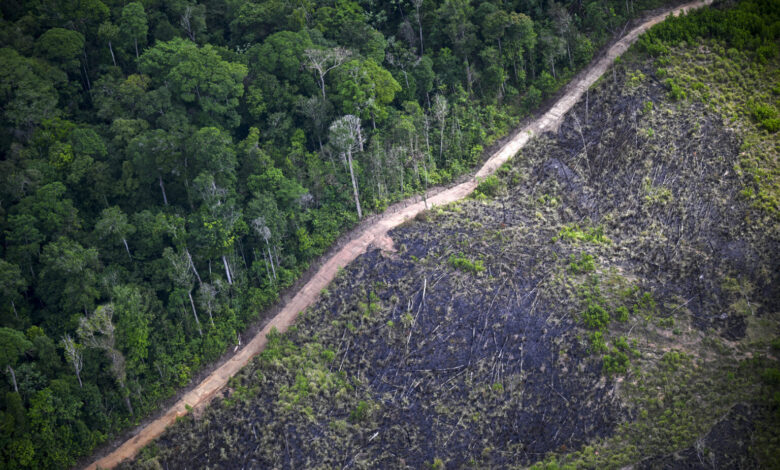
In 2026, the Amazon recorded the smallest area under deforestation alerts in the historical series: 2,874 km2, a 36% drop compared to last year (4.495 km2). The figures from the Deter (Real-Time Deforestation Detection System), released this Friday (7th) by Inpe (National Institute for Space Research), increase the chances that Brazil will record an equally historical record drop in deforestation rates when final data is released, in the coming months.
They also prove that the country has found the formula to control tropical forest destruction, applying the same set of public policies that halted both the chainsaws and greenhouse gas emissions at the beginning of the century.
According to Inpe data, the alerts area measured in the 12 months between August 2025 and July 2026 (the deforestation “fiscal year”) is the lowest since 2016, when the current Deter series began.
In the four years of Luiz Inácio Lula da Silva’s third term, the area under alerts in the Amazon totaled 19,642 km2, a 41% drop compared to the 2019-2022 period, which recorded 33,400 km² (about the area of Belgium).
Deter uses satellite imagery produced in near real-time to guide environmental inspections done by Ibama (the Brazilian federal environmental agency), but it is “short-sighted” due to its relatively low resolution. Therefore, it is not used to calculate the total deforested area, a function that belongs to another Inpe system, Prodes, whose estimates are published at the end of every year. However, Deter data in the last few years, due to technological improvements, has allowed officials to anticipate how Prodes will behave.
If the nearly one-third decline on clearcutting recorded by Deter in 2026 is confirmed by Prodes, Brazil will likely post its lowest official deforestation rate since satellite monitoring began in 1988. “The numbers presented today are historic, the result of serious environmental protection policies, and prove that it is entirely possible to fulfill the commitment made by the country to zero and reverse deforestation by 2030,” says Marcio Astrini, executive secretary of the Brazilian NGO Observatório do Clima.
The data also has a direct impact on Brazil’s emission trajectory, as almost half of all the carbon the country releases into the atmosphere every year comes from forest destruction. According to calculations by Seeg (Greenhouse Gas Emissions and Removals Estimation System), a project of the Observatório do Clima, the reduction in deforestation reported by Deter between 2023 and 2026 prevented the release of 2,238 billion tons of CO2 equivalent (GtCO2e) into the atmosphere, an amount equivalent to the total gross emitted by the country in one year. Seeg’s deforestation emissions estimates are produced by Ipam (the Amazon Environmental Research Institute).
As seen between 2005 and 2012, the drop in deforestation occurs while agricultural production – and the sector’s gains – increases: a study by CNA (Brazilian Agriculture and Livestock Confederation), in partnership with Cepea-Esalq/USP, shows that the Brazilian agribusiness GDP and production volume grew 12.2% and 6.76%, respectively, in 2025. The total value generated by the sector’s activities increased from R$2.5 trillion in 2022 to R$3.2 trillion last year.
The reduction in deforestation also has an important effect during El Niño events. With less forest clearing, there is less fuel to catch fire, which reduces the chances of uncontrolled forest fires like those seen in 2023 and 2024.
However, not all is a celebration. At this exact moment, Brazilian members of Congress are preparing an offensive against Brazilian environmental legislation, with projects aimed at weakening Ibama’s capacity to act, granting amnesty to land grabbers (grileiros), decreasing protection for Conservation Units, and relaxing the Forest Code and other rules for protecting native vegetation.
The reduction in deforestation also faces “friendly fire”. In June of this year, Dnit (Brazil’s National Department of Transport Infrastructure), an agency linked to the Ministry of Transport, authorized—without proper environmental licensing—the paving of stretches of the BR-319 highway (connecting Porto Velho, the capital of Rondônia state, to Manaus, the capital of Amazonas state), which cuts through the most preserved region of the Amazon. According to scientists, the paving could lead to an escalation of deforestation in the region, with the emission of 8 billion tons of CO2 equivalent by 2050, four times more than what was saved by the reduction in deforestation alerts over four years.
“The reduction in deforestation rates is the Lula government’s greatest environmental legacy and one of the largest contributions given to the climate agenda in recent years. However, the end of our forests’ destruction will only be possible with a major change in Parliament, in addition to resolving contradictions within the government itself,” says Astrini. “We will have the chance to do that three months from now, when we choose the next National Congress”.
About Observatório do Clima – Founded in 2002, it is the main network of Brazilian civil society organizations acting in the climate agenda. It currently brings together 172 members, including socio-environmental organizations, research institutes, and social movements. Its goal is to help build a decarbonized, egalitarian, prosperous, and sustainable Brazil.
Press Information
Solange A. Barreira – Observatório do Clima
solange@solange+55 11 9 8108-7272
https://oc.eco.br/en/amazon-deforestation-alerts-hit-all-time-low-in-2026