
Biogas in developing countries turning waste into energy
The conversation around clean energy in rural, developing communities often stumbles into a common trap: treating technology as a copy-and-paste solution. We drop high-tech apparatuses into places with unique ecosystems, microclimates, and economic realities, then express surprise when the equipment falls into disrepair within two years.
Biogas holds massive potential for the energy transition across developing nations, but only if we stop treating it as a standard infrastructure project and start treating it as an engine for local autonomy.
Beyond the Digester: The Circular Reality
Every day, rural agricultural hubs produce tons of organic material livestock manure, crop residues, market food waste, and wastewater. Unmanaged, this waste rots openly, releasing high-impact methane into the atmosphere while degrading local groundwater.
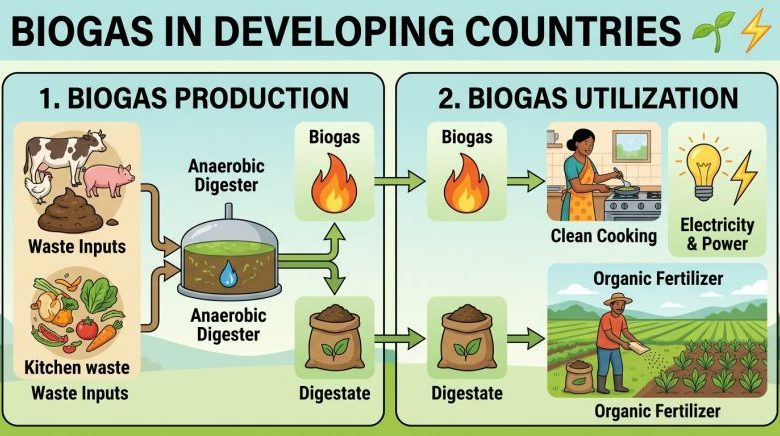
Anaerobic digestion interrupts this cycle, reframing waste as an input rather than a burden:
 Organic Waste  ──>  Anaerobic Digestion  ──>  Biogas (Fuel & Power)
                                         └──>  Digestate (Bio-Fertilizer)
By sealing organic material in an oxygen-free environment, microbial communities process the waste into two yields:
- Clean Methane (Biogas): Replaces firewood and charcoal, immediately reducing indoor air pollution—a critical health hazard that disproportionately impacts women and children—while cutting local deforestation rates.
- Nutrient-Rich Digestate: A powerful, pathogen-reduced bio-fertilizer that reduces dependence on expensive synthetic inputs, restoring soil structure and returning carbon to the land.
Why Digesters Fail (And How to Fix It)
Installing a dome or membrane in the ground is the easy part. Building a system that functions for a decade requires engineering around human and operational constraints.
| Failure Point | Traditional Approach | Adaptive Design Approach |
| Feedstock Variation | Assuming consistent daily input of a single manure type. | Designing flexible digestion chambers that handle seasonal agricultural residues and food waste mixes. |
| Maintenance | Relying on imported replacement parts and foreign technicians. | Utilizing locally manufacturable components and building local technician networks for rapid repairs. |
| Economics | Viewing the system purely as a cost center for waste management. | Monetizing both energy (heat/power) and digestate sales to create self-sustaining revenue streams for farmers. |
| Community Ownership | Imposing top-down technology installations. | Co-designing systems around local daily routines, labor availability, and specific heating or cooking needs. |
The Real Question Forward
We no longer need proof of concept; anaerobic digestion is a proven bio-chemical process. The true challenge is structural, financial, and socio-technical:
How do we build decentralized biogas systems that adapt to local ecosystems, run on local capacity, and generate immediate economic value for the people maintaining them?
When designed around local demand rather than foreign assumptions, biogas becomes more than renewable fuel it becomes the backbone of a resilient, self-funding circular economy.
source:
https://lnkd.in/p/g5SwH_mk


