Capital Market
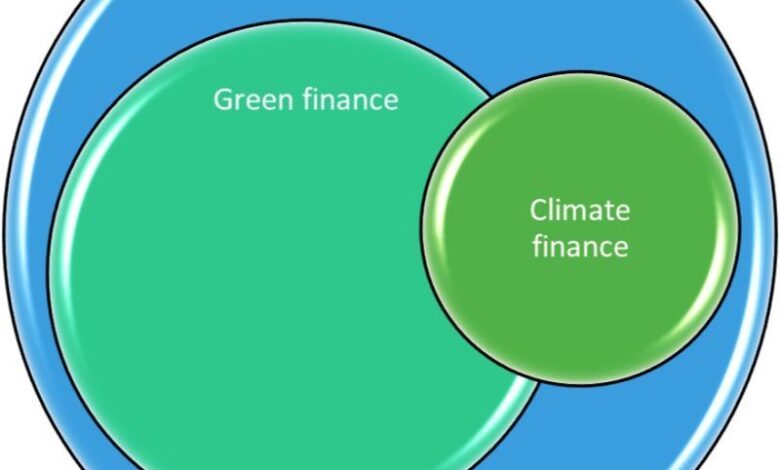
Decoding Sustainable, Green, and Climate Finance
In modern capital markets, these terms are often used interchangeably, but for a Chief Sustainability Officer (CSO) or an Institutional Investor, the nuances define the legal frameworks, reporting standards, and risk profiles of an asset.
The Strategic Hierarchy: An “Umbrella” Architecture
To understand the flow of capital, one must see these not as separate silos, but as nested layers of specificity.
1. Sustainable Finance (The Ecosystem)
The Broadest Lens: This is the integration of ESG (Environmental, Social, and Governance) factors into the entire financial DNA of an institution. It isn’t just about “doing good”; it’s about mitigating long-term systemic risk.
- The “S” & “G”: Unlike the others, this includes Social (human rights, diversity, labor standards) and Governance (board ethics, executive pay).
- Key Instrument: Sustainability-Linked Bonds (SLBs). These are unique because the money can be used for general corporate purposes, but the interest rate “steps up” if the company fails to meet pre-defined ESG targets.
- Goal: Holistic corporate transformation.
2. Green Finance (The Environmental Filter)
The Asset Focus: This is a subset of Sustainable Finance. It moves away from the “Social” and “Governance” aspects to focus purely on Environmental outcomes like biodiversity, water conservation, and pollution control.
- The “Use of Proceeds”: Unlike Sustainable Finance, Green Finance is usually project-specific. The capital is “ring-fenced” for a specific green asset.
- Key Instrument: Green Bonds. These must adhere to strict taxonomies (like the EU Taxonomy) to ensure the money actually goes to “Green” projects like circular economy initiatives or waste management.
- Goal: Directing capital to nature-positive assets.
3. Climate Finance (The Carbon Laser)
The Critical Subset: This is the most narrow and urgent layer. It focuses exclusively on Climate Change specifically Mitigation (stopping warming) and Adaptation (surviving the warming that is already here).
- The Carbon Metric: Success here is measured in tonnes of CO2 equivalent reduced or degrees of warming averted.
- Key Instrument: Transition Bonds. These help “brown” industries (like steel or shipping) fund the expensive shift to “green” technology.
- Goal: Decarbonization and climate resilience.
Comparative Framework at a Glance
| Feature | Sustainable Finance | Green Finance | Climate Finance |
| Primary Goal | Long-term ESG Value | Environmental Health | Net-Zero & Resilience |
| Key Metric | ESG Scores/Ratings | Biodiversity/Resource Efficiency | Carbon Footprint (CO2e) |
| Typical Project | Affordable Housing | Wastewater Treatment | Carbon Capture / EV Infrastructure |
| Strategy | Holistic / Governance-led | Project / Asset-led | Risk / Transition-led |
The Investor’s Cheat Sheet
The Rule of Inclusion:
- All Climate Finance is Green.
- All Green Finance is Sustainable.
- BUT: A project to build a local hospital is Sustainable (Social), but it is not Green or Climate finance. A project to protect a coral reef is Green, but if it doesn’t directly impact carbon sequestration, it might not be strictly Climate finance.
Why This Matters Right Now
As global regulators (like the SEC and EFRAG) tighten disclosure rules, “Greenwashing” often happens because of a misunderstanding of these tiers.
- Investors use this hierarchy to build “Impact Portfolios.”
- Corporates use it to tap into cheaper capital via ESG-linked credit lines.
source: