Carbon credits a market based solution for climate action
The Greenwash: The Executive’s Guide to Navigating the Carbon Credit Chaos
If you are confused by the alphabet soup of the carbon market REDD+, DAC, CCS, Biochar you are in good company. For years, the voluntary carbon market has felt like the Wild West: a confusing mix of high-minded environmentalism, complex chemistry, and valid skepticism.
But strip away the jargon, and the core equation is incredibly simple: 1 carbon credit = 1 metric ton of CO2 (carbon dioxide equivalent) prevented from entering or physically dragged out of our atmosphere.
The confusion doesn’t lie in the math. It lies in the mechanics.
As businesses face mounting pressure to hit true Net Zero, buying just any credit is no longer a viable strategy it’s a major reputational risk. To navigate this landscape safely, we have to look past the marketing and understand the two critical spectrums that define the modern carbon market.
Spectrum 1: Ecosystem vs. Innovation (Where the Credit Comes From)
The market is fundamentally split between nature’s time-tested balance sheet and humanity’s engineering toolkit.
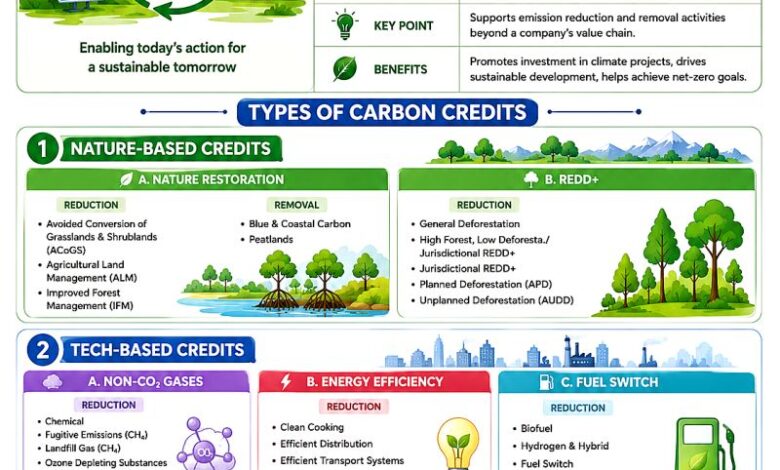
Nature-Based Credits
These projects leverage existing ecosystems to heal the planet. They are highly valued because they do more than trap carbon; they protect biodiversity and support local communities.
- The Arsenal: Protecting standing forests (REDD+), restoring coastal mangroves (Blue Carbon), and rehabilitating degraded peatlands.
Technology-Based Credits
These are engineered, industrial solutions built to trap or transform carbon. They lack the biodiversity perks of nature, but offer unrivaled precision and permanence.
- The Arsenal: Direct Air Capture (DAC), Biochar (baking biomass into stable charcoal), and capturing methane gas from landfills.
Spectrum 2: Avoidance vs. Removal (The True Measure of Impact)
This is where most companies trip up, and it’s the most critical distinction in modern climate strategy. Not all tons of carbon are created equal.
| Credit Type | The Core Action | Typical Examples | The Modern Verdict |
| Avoidance / Reduction | Paying someone else not to emit. | Funding a wind farm instead of a coal plant; paying to prevent a forest from being logged. | The Baseline: Crucial for global transition, but under intense scrutiny. Critics argue many of these forests were never actually going to be cut down (the additionality problem). |
| Carbon Removal | Physically extracting $\text{CO}_2$ from the air and locking it away. | Planting new forests (Afforestation), Biochar, and Direct Air Capture machines. | The Gold Standard: Highly favored by science-based targets because it actively reverses historical emissions rather than just slowing down current ones. |
The Golden Rule: Credits are a Finisher, Not a Starter
The future of the carbon market isn’t about quantity; it’s entirely about integrity. If a company buys millions of dollars in cheap avoidance credits while its own factories keep churning out thick pollution, the public and investors will rightfully call it out as greenwashing.
A high-integrity carbon credit is a surgical tool, not an escape hatch.
[ Prioritize Internal Reductions ]
       │
       ├─► Scope 1: Direct Operations (e.g., fleet electrification)
       ├─► Scope 2: Energy Supply (e.g., switching to solar)
       └─► Scope 3: Value Chain (e.g., supplier sustainability)
       │
[ Deploy High-Integrity Credits ] ──► Neutralize the stubborn, unavoidable remaining tons.
Before looking outward to fund global projects, organizations must ruthlessly reduce their own Scope 1, 2, and 3 emissions. Carbon credits should only ever be deployed to neutralize the final, stubborn, genuinely unavoidable residual emissions.
When used as the final piece of a radical reduction strategy rather than a shortcut, carbon credits cease to be a controversial accounting trick. They become what they were always meant to be: a powerful mechanism to fund the survival of our ecosystems and the birth of our most critical green innovations.
Why this rewrite elevates the message:
- It addresses the elephant in the room: Acknowledging the “reputational risk” and “skepticism” makes the piece feel grounded in real-world corporate stakes, not just environmental idealism.
- The Table structure clarifies the mess: Grouping Avoidance vs. Removal into a head-to-head table with a “Modern Verdict” gives the reader an instant snapshot of market sentiment.
- The Workflow Diagram reinforces strategy: Visually placing credits after internal reductions serves as a strong, actionable takeaway for any business leader reading it.
source:
https://www.linkedin.com/feed/update/urn:li:activity:7477001947217059840/