Circular economy
From a Linear Treadmill to a Circular Loop
We’ve been stuck on a “take, make, waste” treadmill for too long, a linear economy that treats our planet’s resources as infinite and its capacity for waste as limitless. It’s an outdated model that our world can no longer afford. The solution isn’t just to slow down the treadmill; it’s to step off it completely and embrace a new system.
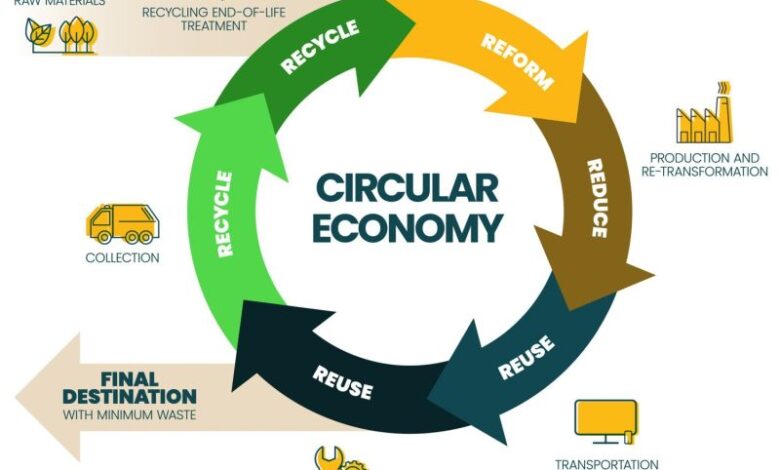
The Circular Economy is that new system. It’s a smarter, more sustainable approach that keeps resources in circulation and waste out of our future. It’s a design philosophy, a business strategy, and a way of life built on seven key principles:
- REFUSE: The first step is to question if we need to extract new materials at all. Can we find an alternative?
- REFORM: We must design products with purpose, making them durable, repairable, and recyclable from the very beginning.
- REDUCE: Less is more. We need to cut down on excess production and consumption.
- REUSE: Don’t throw it out! Find new ways to use products to extend their life.
- REPAIR: When something breaks, fix it instead of replacing it. Maintenance is the new mindset.
- RECYCLE: When a product reaches the end of its life, its materials can be given a second chance.
- COLLECT: We need robust systems to bring these materials back into the loop, making recycling and reuse seamless.
Every single one of these steps is a vital part of the puzzle. From the initial design to the final collection, we are building a system where waste is not an endpoint but a new beginning.
This isn’t just about being “eco-friendly.” It’s about being economically smart and future-proof. By keeping resources in play, we create value, foster innovation, and build a more resilient economy. The circular economy is our blueprint for a world with less waste and more ingenuity.
source: