Circular economy guidebook for cities
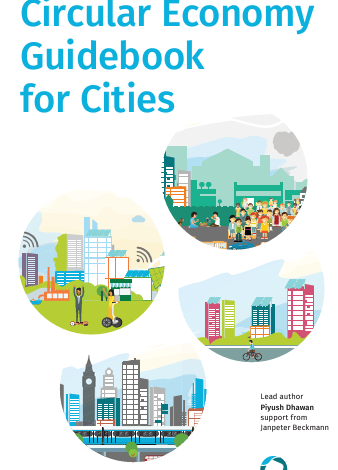
Globally, 3 million people move to urban areas every week. 54% of the world’s population live in urban areas, and cities account for 85% of global GDP generation1. With only 1% of the world‘s total land mass, they are home to over 50% of the human population (Wang, Lee, Zhang, Chen, & Li, 2018). Cities are also aggregators of materials and nutrients, accounting for 75% of natural resource consumption, 50% of global waste production, and 60- 80% of greenhouse gas emissions (Ellen Macarthur Foundation, 2017). As Christopher Chase-Dunn has pointed out, it is not population or territorial size that drives world-city status, but economic weight, proximity to zones of growth, political stability, and attractiveness for foreign capital. In other words, connectivity matters more than size. Cities thus deserve more nuanced treatment on our maps than simply as homogeneous black dots (Khanna, 2016). In 2020, we will witness the coming of age of the first cohorts of the Generation C (“C” for connected) that have lived their entire lives surrounded by the digital world. By then, the four horsemen of the Fourth Industrial Revolution – automation, augmented reality, cloud computing, and ambient intelligence – will have ushered in Industry 4.0 in all its digital splendour (Puutio, 2018). 1World Bank, Urban Development Overview (March, 2017), https://bit.ly/2CIyDpZ Cities, particularly in developing countries face multiple major challenges, including a rapid increase in urban populations with limited access to social services, burgeoning municipal waste generation, inefficient infrastructures and air pollution. People are generally striving for a higher degree of well-being, one of the main motivations of moving to cities, but it appears that urban consumption and modern lifestyles are only partially fulfilling this desire. Having said that, cities in developed countries also face huge challenges related to reducing resource and energy requirements and climate change, as well as social challenges related to deprived groups, shrinking populations, decreasing labour conditions, and withdrawal of the welfare state. Citizens in developing countries are more concerned about getting a livelihood, in the developed countries the emphasis has been more on moderation of lifestyles and reducing resource and energy intensity of lifestyles (Future Earth KAN SSCP Working Group, 2018).
source :
https://www.cscp.org/wp-content/uploads/2019/03/Circular_Cities_Publication.pdf