Space Syntax
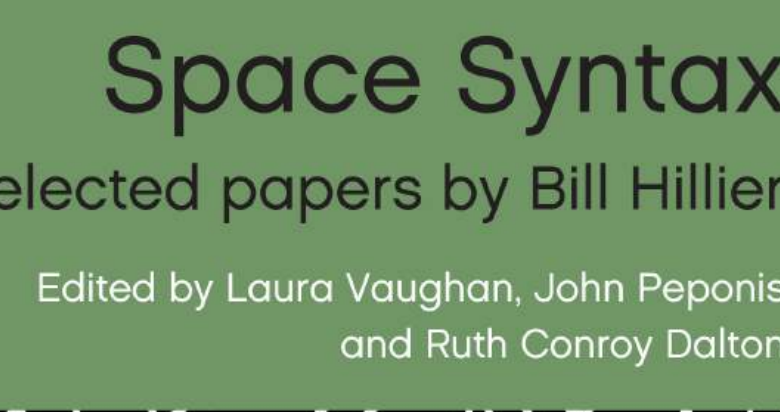
This publication marks the 50th anniversary of space syntax, a pioneering architectural research program initiated by Bill Hillier and colleagues in the early 1970s. Hillier’s foundational work began at the Royal Institute of British Architects (RIBA), and in 1974, he was appointed Director of the Unit for Architectural Studies at The Bartlett School of Architecture and Planning, University College London (UCL). That same year, his seminal paper “How is design possible?” (co-authored with Adrian Leaman) was published, followed in 1976 by the first article explicitly outlining the space syntax research program, written with Leaman, Paul Stansall, and Michael Bedford. These early works—along with subsequent papers that expanded the theory—are presented in this volume as freshly illustrated transcriptions.
Theoretical Milestones
- 1984: Hillier, with collaborator Julienne Hanson, published The Social Logic of Space, the first comprehensive theoretical framework for space syntax.
- 1988: The discipline’s influence beyond academia became evident with Norman Foster’s King’s Cross masterplan, which applied space syntax principles.
- 1989: Space Syntax Ltd was founded to bridge research and practice, offering expertise in design, policy, and performance modeling.
- 1996: Hillier’s Space is the Machine refined the theoretical foundations of the field.
Global Expansion
The first International Space Syntax Symposium was held in London (1997), followed by 13 biennial symposia across cities like Brasília, Atlanta, Istanbul, Seoul, Beijing, and Nicosia (2024). Today, space syntax research thrives in universities worldwide, with over 3,000 scientific papers (per Web of Science) and a growing body of scholarly books. Its methods and ideas are increasingly integrated into architecture, urban design, planning, archaeology, anthropology, sociology, and computational spatial analysis.
This Volume: A Focus on Hillier’s Foundational Ideas
Rather than a comprehensive history of space syntax, this book traces the evolution of Bill Hillier’s key contributions through selected papers (1974–2012). Each paper is accompanied by a critical essay from a contemporary scholar, offering:
- Contextual significance,
- Analytical commentary,
- Potential avenues for future research.
The Introduction synthesizes the theoretical underpinnings, while the original texts are reproduced with minimal corrections to preserve their historical integrity.
Enduring Impact
Few architectural research programs have sustained such consistent development and practical application over five decades. Hillier’s work remains essential not only to architects but also to scholars across diverse fields, as reflected in the rising citation counts of his major publications. This collection invites readers to engage critically with ideas that continue to shape our understanding of space, society, and design.
Key Features of the Book:
- Landmark papers from 1974–2012, illustrating Hillier’s intellectual trajectory.
- Commentaries by leading scholars to contextualize and critique each work.
- Interdisciplinary relevance, bridging architecture, social sciences, and computational analysis.
This version organizes the text into clear sections, emphasizes key milestones, and improves flow while preserving all original details. Let me know if you’d like further adjustments!
Source:
https://discovery.ucl.ac.uk/id/eprint/10207360/1/Space-Syntax.pdf