Confused between ESG, Sustainability, EHS, and CSR
Confused between ESG, Sustainability, EHS, and CSR❗🤷♂️
Understanding the difference is essential for building an effective sustainability strategy and managing corporate responsibilities.
Each framework has a different purpose, focus, and set of stakeholders.
Here is how they differ:
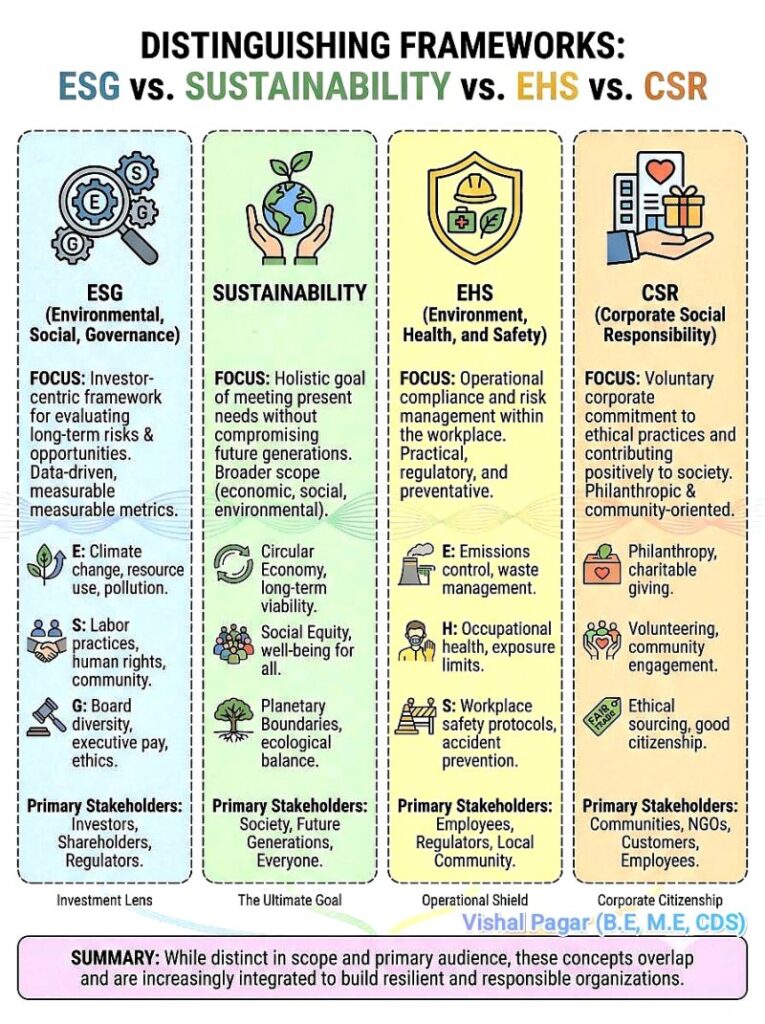
1. ESG – Environmental, Social & Governance
ESG is primarily an investor-focused framework used to evaluate an organization’s long-term risks, opportunities, and performance.
* Environmental: Carbon emissions, climate change, resource consumption, and pollution.
* Social: Human rights, employee welfare, labor practices, and community impact.
* Governance: Board diversity, business ethics, executive compensation, and transparency.
2. Sustainability – Long-term Sustainable Development
Sustainability takes a broader, holistic approach to balancing environmental protection, social well-being, and economic development.
* Circular economy and resource efficiency.
* Social equity and human well-being.
* Planetary boundaries and ecological balance.
* Meeting present needs without compromising future generations.
3. EHS – Environment, Health & Safety
EHS focuses on operational compliance, workplace safety, environmental protection, and risk prevention.
* Environmental compliance, emissions, and waste management.
* Occupational health and employee exposure.
* Workplace safety protocols and accident prevention.
4. CSR – Corporate Social Responsibility
CSR reflects an organization’s voluntary commitment to ethical business practices and creating positive social impact.
* Philanthropy and charitable contributions.
* Employee volunteering and community engagement.
* Ethical sourcing and responsible business practices.
* Supporting local communities.
The biggest takeaway?
These four concepts are different, but they are interconnected.
Think of them this way:
* ESG measures and communicates sustainability-related performance and risks.
* Sustainability defines the broader long-term vision.
* EHS manages environmental and workplace risks at the operational level.
* CSR demonstrates corporate responsibility toward society.
A mature organization does not treat these as isolated initiatives. It integrates them into its business strategy, operations, decision-making, and reporting.
The future belongs to organizations that move beyond compliance and reporting to create measurable, long-term positive impact.
Which of these four frameworks does your organization focus on the most?