ESG (environmental, social and governance) abbrevations
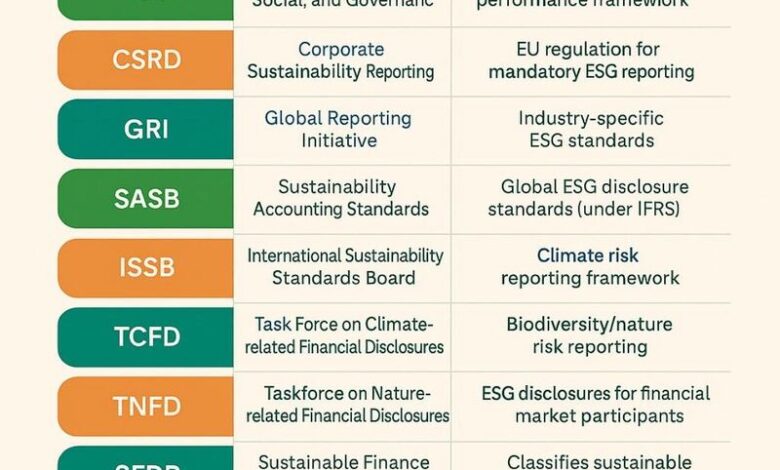
In an era where a company’s value extends far beyond its bottom line, Environmental, Social, and Governance (ESG) has emerged as the new language of business. This isn’t just a trend; it’s a fundamental shift in how the world assesses corporate health. As the landscape of ESG matures, a complex yet crucial alphabet of frameworks and standards has emerged, turning what was once optional “green” behavior into non-negotiable business practice.
Decoding the Alphabet Soup
While the acronyms may seem like a jumble, each one represents a powerful mechanism designed to bring transparency and accountability to the global market. Think of them as the building blocks of a more sustainable economy.
- CSRD (Corporate Sustainability Reporting Directive): The European Union’s game-changing directive that mandates large companies to publicly disclose detailed information on their sustainability performance. It’s a strict new rule designed to put ESG on par with financial reporting.
- GRI (Global Reporting Initiative): A widely used, independent standard-setter that provides comprehensive guidelines for companies to report on their economic, environmental, and social impacts. GRI helps companies tell their full sustainability story.
- SASB (Sustainability Accounting Standards Board): Now under the IFRS Foundation, SASB focuses on creating industry-specific ESG reporting standards. Its goal is to provide investors with financially material, decision-useful information, making ESG data as relevant as financial data.
- ISSB (International Sustainability Standards Board): The global standard-setter aiming to create a comprehensive framework for sustainability-related financial disclosures. It’s a key piece of the puzzle, providing a global baseline for climate risk reporting.
- TNFD (Taskforce on Nature-related Financial Disclosures): A groundbreaking framework that asks companies to go beyond climate and report on risks and opportunities related to nature and biodiversity loss. It’s the next frontier in ESG, bringing nature to the balance sheet.
- SFDR (Sustainable Finance Disclosure Regulation): An EU regulation that classifies financial products based on their sustainability goals, helping investors understand if an investment is truly “green.”
- SDGs (Sustainable Development Goals): A set of 17 global goals adopted by the United Nations. They provide a universal blueprint for a better and more sustainable future for all, guiding businesses, governments, and individuals.
- CSDDD (Corporate Sustainability Due Diligence Directive): An upcoming EU law that will require companies to address human rights and environmental impacts throughout their value chains. It’s about ensuring that a company’s supply chain is ESG-proof.
Why It All Matters
This isn’t just about compliance; it’s about competitive advantage and long-term viability. The market is changing, and the rules are being rewritten.
- Investors are increasingly using ESG data to make decisions, preferring companies that demonstrate strong risk management and ethical practices. They want proof, not just promises.
- Customers are more conscious than ever, choosing brands that align with their values and rejecting those perceived as “greenwashing.”
- Regulators are turning these voluntary frameworks into mandatory requirements, making ESG reporting a non-negotiable part of doing business.
The future belongs to companies that don’t just embrace ESG but embed it in their core strategy. They will be the ones that attract capital, build trust, and lead the transition to a sustainable, net-zero economy.
The Big Question
Each of these frameworks has immense power, but which one will truly shape the next decade? The CSRD has regulatory teeth and will force immediate change in the world’s largest economic bloc. The SDGs provide the overarching vision that guides every other framework. The TNFD is a new and critical evolution, bringing nature to the forefront of financial risk. The real impact will likely be a combination of all three: regulation like the CSRD will mandate change, the SDGs will provide the moral compass, and new frontiers like the TNFD will redefine the boundaries of accountability.
source: