ESG frameworks & global standards
The landscape of Environmental, Social, and Governance (ESG) reporting relies on standardized global frameworks and standards. As corporate reporting shifts from voluntary disclosure to mandatory compliance, understanding how these frameworks interact and how local market regulators integrate them is essential for corporate strategy, financial assurance, and capital allocation.
1. Global ESG Frameworks & Standards Architecture
Global disclosure tools are divided into Frameworks (which provide high-level reporting principles and concepts) and Standards (which specify exact, quantifiable disclosure metrics).
Core Global Standards & Frameworks
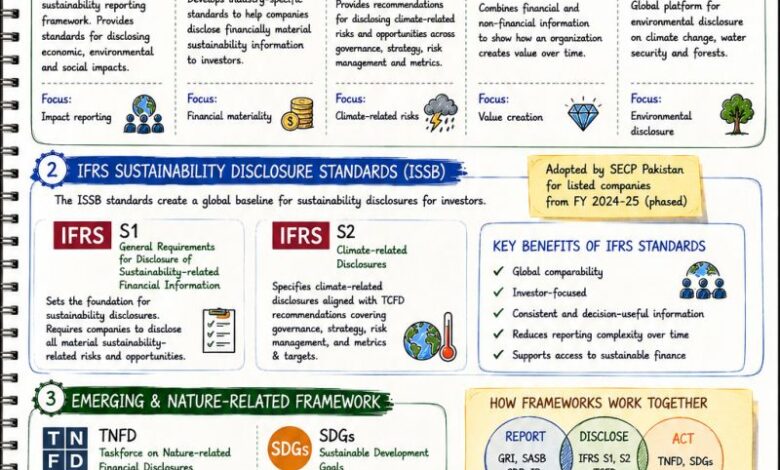
- ISSB (IFRS S1 & IFRS S2): Established by the International Sustainability Standards Board under the IFRS Foundation to serve as the global baseline for financial sustainability disclosures:
- IFRS S1: General requirements for disclosure of sustainability-related financial information.
- IFRS S2: Specific climate-related disclosures, incorporating physical risks, transition risks, and climate scenario analysis.
- GRI (Global Reporting Initiative): The widely adopted global standard for impact materiality, measuring an organization’s economic, environmental, and social impact on broader society and the planet.
- TCFD (Task Force on Climate-related Financial Disclosures): Developed a 4-pillar framework (Governance, Strategy, Risk Management, Metrics & Targets) for climate risk reporting. Note: TCFD monitoring responsibilities formally merged into ISSB IFRS S2.
- SASB (Sustainability Accounting Standards Board): Industry-specific disclosures focused on financially material ESG topics across 77 industries. Note: Integrated into the IFRS Foundation to support ISSB.
- TNFD (Taskforce on Nature-related Financial Disclosures): A risk management and disclosure framework modeled on TCFD, focusing on organizational impacts, dependencies, risks, and opportunities related to nature and biodiversity.
- UN SDGs (Sustainable Development Goals): 17 global goals providing a strategic blueprint for organizations to align their sustainability targets with global development priorities.
2. Framework Comparison & Materiality Alignment
Different reporting tools target different audiences and operate under distinct materiality principles:
| Framework / Standard | Primary Audience | Materiality Lens | Primary Objective |
| ISSB (IFRS S1/S2) | Investors, Lenders, Capital Markets | Financial Materiality (Outside-In) | Evaluate how ESG risks affect enterprise value |
| GRI Standards | Multi-stakeholder (Public, NGOs, Investors) | Impact Materiality (Inside-Out) | Disclose corporate impact on society and environment |
| EU CSRD (ESRS) | EU Regulators, Investors, Stakeholders | Double Materiality (Financial + Impact) | Comprehensive mandatory ESG disclosure baseline |
| TNFD | Financial Institutions & Enterprise Leaders | Financial & Environmental Dependencies | Assess nature-related financial risks and impacts |
| UN SDGs | Global Community, Policy Makers | Macro-Developmental Impact | Universal benchmark for sustainable development |
3. Interoperability & Harmonization Building Blocks
[Financial Materiality: ISSB / SASB] ──┐
                                       ├──> Integrated Double Materiality Reporting Framework
[Impact Materiality: GRI / TNFD]    ──┘
The global sustainability reporting ecosystem is consolidating:
- ISSB as the Financial Baseline: Serves as the global standard for investor-oriented climate and financial disclosures.
- GRI as the Impact Baseline: Works alongside ISSB through explicit interoperability agreements, enabling companies to report both financial risk and societal impact seamlessly.
- Consolidation of Legacy Frameworks: Historical frameworks such as TCFD, SASB, and the International Integrated Reporting Council (IIRC) have been absorbed into ISSB, streamlining global reporting.
4. Regional Implementation: The Pakistan Regulatory Landscape
In Pakistan, regional regulatory bodies are systematically aligning national corporate reporting standards with international ESG baselines:
[SECP: Policy & Governance Mandates]
        │
        ├──> [PSX: Market Listing Rules & ESG Reporting Guidelines]
        │
        └──> [ICAP: Sustainability Accounting & ISSB Assurance Standards]
- SECP (Securities and Exchange Commission of Pakistan): Establishes national disclosure roadmaps, Code of Corporate Governance regulations, and policy frameworks for environmental and social compliance.
- PSX (Pakistan Stock Exchange): Drives market-level adoption through the PSX ESG Reporting Primer, providing listed entities with reporting templates aligned with GRI and ISSB metrics.
- ICAP (Institute of Chartered Accountants of Pakistan): Technical body guiding the adoption of IFRS S1 and IFRS S2 standards, training auditors, and defining assurance protocols for sustainability data.
20-Part ESG Fundamentals Series Roadmap
- Part 1: Introduction to ESG: Foundations & Value Creation
- Part 2 & 2B: History & Evolution of ESG (Global & Pakistan Landscape)
- Part 3: ESG Terminology Every Professional Should Know
- Part 4: ESG Frameworks & Global Standards (Current)
- Part 5: Environmental (E): The First Pillar of ESG (Next Up)
- Part 6–20: Social & Governance Deep Dives, Carbon Accounting, and Implementation Blueprints
source: