
Financial Value of Climate Risks and Opportunities
Financial Value of Climate Risks and Opportunities
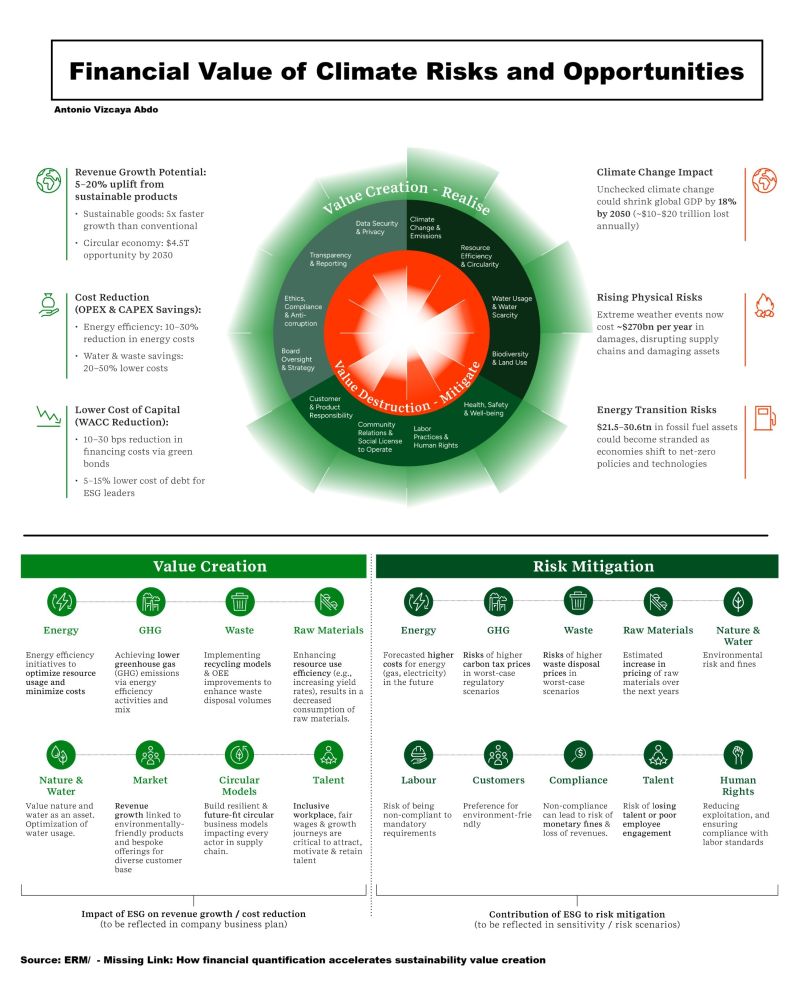
Companies are under increasing pressure to reflect climate risks and opportunities in financial decision making. This is essential for embedding sustainability into strategy and unlocking measurable business value.
ERM highlights that financial valuation of environmental and social factors enables companies to align investment decisions with long term performance. Value is created through energy efficiency, circular models, responsible sourcing, and workforce inclusion. These actions contribute to resilience, innovation, and cost efficiency.
Sustainable products are experiencing significantly higher growth rates than conventional alternatives. Efficiency measures can reduce operating costs by up to 30 percent, while green finance instruments can lower the cost of capital. These gains can be captured directly in financial models and forecasts.
At the same time, climate related risks are increasing in scale and frequency. Physical risks already account for over 270 billion dollars in annual damages. Transition risks may result in stranded assets worth hundreds of billions. The broader economic cost of unmitigated climate change could reduce global GDP by up to 18 percent by mid century.
ERM presents two complementary approaches. Value creation focuses on capturing upside through efficiency, innovation, and market expansion. Risk mitigation addresses downside exposure by incorporating climate risks into business planning and decision processes. Both require integration of ESG into financial structures.
This means applying standard financial tools such as internal rate of return and discounted cash flow to evaluate climate related actions. It also involves including environmental risks in sensitivity testing, pricing models, and capital planning frameworks. Translating these impacts into financial terms enables clearer comparison and stronger governance.
Capital markets are moving toward companies that manage climate exposure effectively. Lower financing costs, stronger investor confidence, and increased access to sustainability linked capital are all benefits of a robust ESG integration strategy.
Quantifying the financial value of climate related risks and opportunities enables companies to move from qualitative ambition to strategic execution. Those that lead in this area are better prepared to compete, attract capital, and deliver long term results.
Source: ERM


