Germany built staircases that capture energy from footsteps
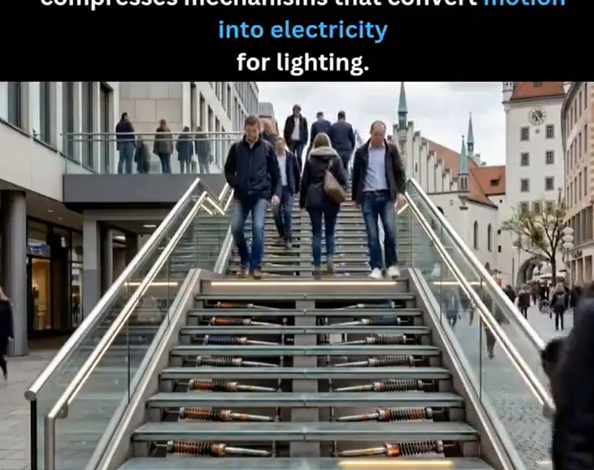
From Passive Concrete to Active Power: The Rise of Kinetic Infrastructure
For a century, our cities have been passive consumers static arrangements of steel and stone that only “cost” energy to maintain. But a new paradigm emerging from European innovation hubs is challenging this inertia. By reimagining the very ground beneath our feet as a decentralized power plant, we are entering the era of Kinetic Infrastructure.
1. Harvesting the “Human Current”
The engineering at the heart of this shift moves beyond traditional solar or wind. It utilizes piezoelectric and electromagnetic conversion to capture the kinetic waste of urban life.
- The Mechanism: Specially engineered tiles and staircases act as transducers. Every heel-strike compresses internal components, inducing a voltage that captures energy that would otherwise dissipate as heat or vibration.
- The Scale: While a single step produces only a few joules, the math changes in a “High-Footfall Ecosystem.” In a transit hub with 50,000 commuters daily, the floor becomes a consistent, predictable energy stream.
2. Decentralization: Powering the “Last Meter”
The strategic value of kinetic energy is not in competing with the national grid, but in solving the “Last Meter” energy problem. By generating power exactly where it is consumed, we eliminate transmission losses and the need for complex wiring in sensitive areas. Kinetic systems provide the perfect autonomous power source for:
- Off-grid lighting and emergency signage.
- Real-time IoT sensors monitoring air quality or pedestrian flow.
- Interactive urban furniture and charging stations.
3. The Psychological Shift: Making Sustainability Tangible
Perhaps the most potent impact of this technology is behavioral. Traditional energy coal, gas, or even remote wind farms is invisible to the consumer. Kinetic floors make sustainability visceral.
When a pedestrian sees an LED display flicker to life with their own footstep, the relationship between human activity and environmental impact is no longer an abstract concept; it is a physical reality. It transforms the citizen from a passive consumer into an active contributor to the city’s energy budget.
4. The Strategic Roadmap for Urban Design
To move from “pilot project” to “urban standard,” architects and city planners must shift their evaluation metrics:
| Metric | Traditional Design | Kinetic Design Paradigm |
| Surface Value | Durability & Aesthetics | Energy Yield per Square Meter |
| Maintenance | Cost to Repair | ROI through Self-Powered Systems |
| Public Role | Wayfinding | Energy Participation |
Conclusion: Engineering the Interactive City
Kinetic energy systems represent the “Internet of Movement.” They point toward a future where cities are no longer energy-hungry voids, but interactive, resource-aware ecosystems.
As we densify our urban centers, we must stop viewing human movement as a logistical challenge to be managed and start seeing it as a renewable energy harvest. Small gains, when multiplied by millions of footsteps, prove that the path to a Net-Zero future is one we can literally walk into existence.
source: