
How is that possible? we explain below
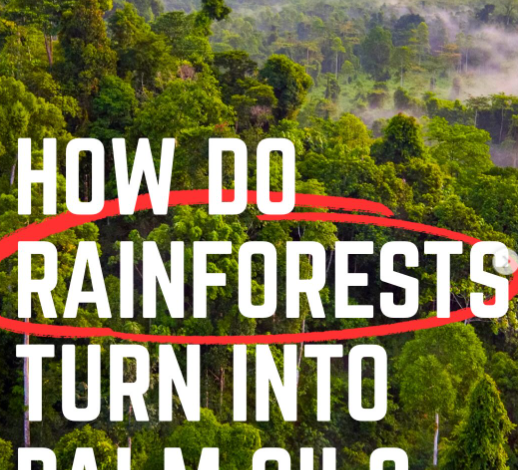
The Geography of Deception: Inside the Mechanics of “Palm Oil Laundering”
Global consumers are frequently reassured by corporate sustainability pledges guaranteeing “zero-deforestation” supply chains. However, investigative data from organizations like the Rainforest Action Network (RAN) reveals a stark systemic vulnerability: illegal palm oil cultivation is actively cannibalizing strictly protected national parks through a process functionally identical to financial money laundering.
This is not a story of marginalized, subsistence farmers encroaching on forest borders to survive. It is a highly organized, capital-intensive white-collar crime executed within the world’s most biodiverse carbon sinks.
The Three-Stage Laundering Pipeline
To understand how a protected rainforest tree transforms into an ingredient in everyday household supermarket products, the supply chain fraud can be broken down into three distinct operational phases:
[ Placement ] ──> Eradication of protected national park canopy via illegal, well-capitalized clearing.
       │
       ▼
[ Layering ]  ──> Commingling illegal fruit with legal smallholder yields to obscure the geographic origin.
       │
       ▼
[ Integration ] ─> Delivery to global refineries, clean-certified and distributed to consumer brands.
1. Placement (The Illegal Extraction)
Powerful, well-connected local elites frequently leveraging political capital, substantial private wealth, or inside knowledge of regulatory loopholes bypass state security. They illegally bulldoze primary rainforests inside national parks, planting monoculture oil palm fields.
2. Layering (Obscuring the Audit Trail)
Major international palm oil traders have strict, on-paper corporate mandates prohibiting the purchase of commodities grown on illegally deforested land. Direct sales would trigger supply-chain audits. To bypass this, syndicates deploy a proxy mechanism: they co-opt or hire legitimate local smallholders situated just outside the park boundaries. The illegal harvest is documented under the smallholder’s legal license, entirely freezing the regulatory paper trail.
3. Integration (Global Distribution)
Once the “dirty” crop is commingled with legal yields at local collection centers, it enters processing mills. Because tracing technologies struggle to separate individual oil palm fresh fruit bunches once mashed, the illegal oil is effectively integrated into the mainstream market. It is shipped to transnational traders, refined, and sold to multinational consumer goods corporations as “certified sustainable” palm oil.
Systemic Realities vs. Corporate Claims
| The Corporate Narrative | The Supply Chain Reality |
| No-Deforestation, No-Peat, No-Exploitation (NDPE) policies protect vulnerable borders. | Enforcement stops at the mill gates; indirect supply chains (third-party dealers) remain highly opaque. |
| Smallholder inclusion programs purely support family-run agricultural models. | Smallholders are frequently weaponized as structural shields by wealthy speculators to mask illicit volumes. |
| Satellites and AI monitoring protect national parks from corporate land grabs. | Satellites detect canopy loss, but they cannot verify who owns the fruit once it leaves the forest floor via unmarked trucks. |
The Structural Core:
Palm oil laundering thrives because international brands rely heavily on “Mass Balance” supply chain models, where sustainable and non-sustainable oils are physically mixed during transit. Until global consumer brands mandate absolute, plot-level geolocation traceability for 100% of their raw materials including third-party middlemen protected national parks will continue to be converted into invisible profits.
source:


