
Newsletter
IEEFA insights digest: global energy transition & climate finance
1. Southeast Asia & South Asia: Energy Transition & Economic Vulnerability
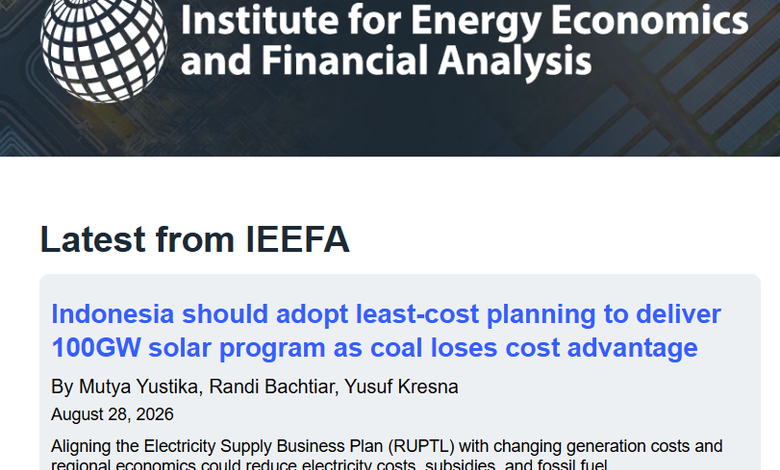
Indonesia: Least-Cost Planning Required for 100GW Solar Target
- Authors: Mutya Yustika, Randi Bachtiar, Yusuf Kresna | August 28, 2026
- Key Takeaway: As coal rapidly loses its long-held cost advantage over renewable energy, Indonesia must modernize its Electricity Supply Business Plan (RUPTL). Adopting a least-cost planning framework will enable the nation to successfully scale up its 100GW solar ambition, cut overall electricity generation costs, lower state energy subsidies, and reduce reliance on fossil fuels.
Bangladesh: Expanding LNG Reliance Increases Economic Risk
- Author: Shafiqul Alam | August 28, 2026
- Key Takeaway: Doubling down on Liquefied Natural Gas (LNG) imports to address domestic power shortages exposes Bangladesh to severe global price volatility and currency risks. IEEFA warns that expanding LNG infrastructure threatens long-term energy security rather than stabilizing the country’s energy crisis.
2. Carbon Markets & Decarbonization Policy: Australia
Australia’s Coal Sector Distorts Carbon Credit Markets
- Author: Andrew Gorringe | August 27, 2026
- Key Takeaway: A comprehensive review of Australia’s Safeguard Mechanism reveals that the coal mining industry is increasingly reliant on purchasing carbon credits to offset methane emissions rather than implementing direct operational cuts. This heavy demand skews the integrity and pricing of the broader carbon credit market, highlighting the need for stricter regulatory limits.
3. Macroeconomics & Industrial Innovation
Inflation Relief in Australia May Be Temporary Due to Geopolitical Shock
- Author: Amandine Denis-Ryan | August 26, 2026
- Key Takeaway: July’s brief inflation dip is unlikely to hold. The delayed macroeconomic ripple effects of soaring global fuel prices driven by the ongoing crisis in Iran are expected to put renewed upward pressure on domestic living and energy costs.
Direct Electrolysis: Reviving Electrochemical Ironmaking for Green Steel
- Author: Soroush Basirat | August 26, 2026
- Key Takeaway: While electrochemical methods are standard in other metal production, direct electrolysis of iron ore is emerging as a critical breakthrough for the global steel industry. Reviving and scaling this process offers a zero-carbon pathway for primary steel production, aligning heavy industry with global net-zero targets.
4. Sustainable Public Finance: India
Jharkhand’s Opportunity to Lead India in Green Budgeting
- Authors: Gaurav Upadhyay, Shantanu Srivastava | August 25, 2026
- Key Takeaway: By embedding a structured green budgeting framework into its public financial management, the state of Jharkhand can align its fiscal spending and public investments with Just Transition priorities, serving as a model for resource-dependent regions transitioning away from fossil fuels.
Executive Summary Matrix
| Region / Subject | Strategic Issue | IEEFA Core Recommendation |
| Indonesia | Coal vs. Solar Grid Integration | Align RUPTL with updated generation economics. |
| Bangladesh | LNG Volatility | Shift focus away from imported LNG dependence. |
| Australia | Industrial Methane & Carbon Offsets | Reform Safeguard Mechanism to limit coal sector reliance on credits. |
| Heavy Industry | Decarbonizing Steel Production | Invest in direct iron ore electrolysis technology. |
| India (Jharkhand) | Climate Fiscal Planning | Implement green budgeting to fund a Just Transition. |
source:
https://21465662.hs-sites.com/ieefa-friday-week-in-review-1787943603000


