
Indonesia pushes mass transportation to ease urban congestion
The Transportation Ministry has stated that integrated and sustainable mass transportation is the solution to traffic congestion, high transportation costs, and the public’s heavy reliance on private vehicles in urban areas.
“Integrated and sustainable mass transportation provides the answer to the problems of traffic congestion, high transportation costs, and the public’s heavy dependence on private vehicles,” the ministry’s Director of Road Transportation at the ministry, Muiz Thohir, said here on Tuesday.
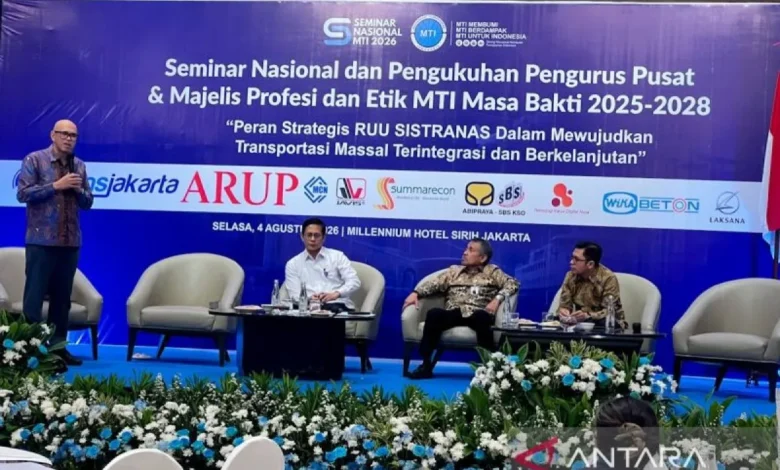
He made the statement while speaking at the National Seminar of the Indonesian Transport Society (MTI), titled “The Strategic Role of the National Transportation System Bill (RUU Sistranas) in Realizing Integrated and Sustainable Mass Transportation,” in Jakarta.
The ministry emphasized that urban mobility is a basic necessity that supports the realization of the Golden Indonesia 2045 vision.
“Although the central government has laid the foundation, the ultimate determinant of success lies in the political will and fiscal commitment of regional governments,” he said.
He noted that the ministry’s latest data showed the country has 172.9 million motor vehicles, growing at an annual rate of 4.5 percent, placing an increasing burden on road infrastructure.
National economic losses caused by traffic congestion are estimated at Rp77 trillion (around US$4.2 billion) annually, he added.
According to him, the urban transportation sector faces significant challenges, with transportation expenses accounting for 16 percent to 24 percent of total household income, based on Statistics Indonesia (BPS) data from 2023.
In addition, the transportation sector accounts for the largest share of energy subsidies, amounting to Rp300 trillion (around US$16.7 billion) annually.
While 58 percent of the population works in the informal sector with incomes below the provincial minimum wage (UMP).
Therefore, he stressed that affordable mass transportation is crucial to supporting the government’s target of achieving 8 percent economic growth, as it expands public access to employment, education, and public services.
“As a concrete measure, the government has launched the Indonesia Mass Transit Project (MASTRAN Project), which prioritizes the development of mass transportation systems in 20 urban areas over the medium term,” he added.
Currently, the Mebidang Area (Medan, Binjai, and Deli Serdang) and the Bandung Basin Metropolitan Area (BBMA), comprising Bandung City, Cimahi City, Bandung District, West Bandung District, and Sumedang District, have been designated as pilot projects with financing support from the World Bank and the Agence Française de Développement (AFD).
In the Mebidang area, the project includes 21 kilometers of dedicated bus lanes, 31 on-corridor bus stops and 681 off-corridor bus stops, 12 routes, and 273 buses.
The system is projected to serve 154,851 passengers per day when operations begin in early 2027 and will be integrated with 109 Area Traffic Control System intersections.
Meanwhile, the BBMA project includes 21 kilometers of dedicated bus lanes, 34 on-corridor bus stops and 719 off-corridor bus stops, 18 routes, and 478 buses.
The BBMA is expected to serve 204,736 passengers per day and will be integrated with 65 Area Traffic Control System intersections.
https://en.antaranews.com/news/425585/indonesia-pushes-mass-transportation-to-ease-urban-congestion


