
Indonesia’s climate actions towards 2030
The report published by the Intergovernmental Panel on Climate Change (IPCC) in April 2022 revealed an alarming fact that Greenhouse Gas (GHG) emissions have caused the earth’s average temperature to rise above 1.5 Celsius. This is critical because the inevitability of global warming may trigger catastrophic climate change-related disasters. In Indonesia, climate change-associated disasters have frequently occurred. For instance, prolonged flooding in Kalimantan due to extreme rainfall, high intensity of forest and land fires in Sumatra due to hot weather, and the rise of sea level on the north coast of Java. In addition to natural disasters, climate change also results in failure of food crops and can create an explosion of disease-carrying vectors such as mosquitoes and flies. In order to curb global GHG emissions, the world acceded to the Paris Agreement in Every single country, including Indonesia,
determined its own target for contributing to GHG emission reduction, in which the target was then set forth in their Nationally Determined Contribution (NDC) document. Indonesia set a target of 29% emission reduction through its own efforts and of 41% with international support. The climate ambition was enhanced in the Updated NDC by strengthening the commitment, which was implemented through several programs, strategies, and actions in the elements of mitigation, adaptation, transparency framework, and other supportive implementation instruments.
In September 2022, Indonesia submitted the Enhanced NDC to the UNFCCC Secretariat. The document contains the increased target of emission reduction from 29 percent to 31.89 percent unconditionally and from 41 percent to 43.20 percent conditionally. Apart from the Enhanced NDC document, the Country submitted the Long-Term Strategy for Low Carbon and Climate Resilience 2050 (LTS-LCCR) document,
determining a vision to enhance national climate action ambition. The document further affirms the
target of Carbon Neutrality, even more, Carbon Net Sink for the FOLU sector by 2030.
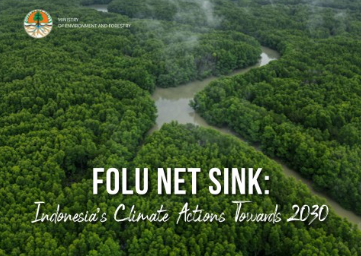
Indonesia’s FOLU Net Sink 2030 means that carbon sequestration from the forestry and other land use (FOLU) sector are higher than, or at least equal to its overall emissions by 2030. Indonesia’s FOLU Net Sink affirms that GHG absorption from the forestry sector is targeted to reach minus 140 megatonnes (Mt) CO
2e by 2030 and then continue to decrease to minus 304 Mt CO2e by 2050.
Indonesia’s FOLU Net Sink 2030 serves as the backbone of Indonesia’s GHG emission reduction. Referring to the LTS-LCCR, Indonesia’s peak GHG emissions are predicted to reach 1,244 million tonnes of CO
2e in 2030 and then decrease to 540 million tonnes of CO2e in 2050. Indonesia is projected to achieve Net Zero Emissions in 2060, wherein GHG absorption is higher than its emissions. Indonesia’s FOLU Net Sink 2030 was first declared to the global community at COP26 to the UNFCCC in Glasgow, the United Kingdom. Through Indonesia’s FOLU Net Sink 2030, the Country takes a “leading by example” position in
mitigating global climate change.


