Island states of the global south and the challenge of building urban climate resilience
As the climate crisis escalates, cities around the world are racing to adapt and mitigate its devastating impacts. Nowhere is this urgency felt more acutely than in island nations—especially those in the Global South—where the very existence of cities and communities hangs in the balance. For these island states, climate-resilient infrastructure is no longer an option; it is a matter of survival.
The Frontlines of Climate Change
With 93 of the world’s 195 countries classified as island nations, nearly half of global governments are naturally more vulnerable to climate-related disasters. Many of these nations belong to the category of Small Island Developing States (SIDS), scattered across the Pacific, Indian, and Atlantic Oceans, as well as the Caribbean. Their proximity to water and isolated geography make them particularly susceptible to rising sea levels, intensified storms, and biodiversity loss.
A recent study analyzing over 5,000 islands worldwide underscores a grim reality: climate change is not just eroding ecosystems, but triggering chain reactions that threaten global biodiversity. Yet, despite these vulnerabilities, island nations are not passive victims. They are mobilizing, advocating, and innovating to carve out a future where their cities can thrive.
Island States Fighting Back
The Maldives’ Foreign Minister, Abdulla Shahid, put it succinctly in a keynote speech last year: island nations may be small, but they are not powerless. Initiatives like the 2014 Samoa Pathway and the 2007 Malé Declaration have demonstrated how island nations can unite to amplify their voices on the global stage. These agreements have propelled climate action and policy commitments, yet geopolitical power struggles often sideline the urgent needs of these vulnerable states.
According to the OECD, SIDS experience some of the highest annual GDP losses due to natural disasters. However, their response is not just about disaster relief—it is about reimagining their urban landscapes for resilience. Across the world, island cities are rethinking their future, from floating neighborhoods to nature-based solutions that blend traditional knowledge with cutting-edge technology.
Singapore: Planning for the Worst, Leading the Way
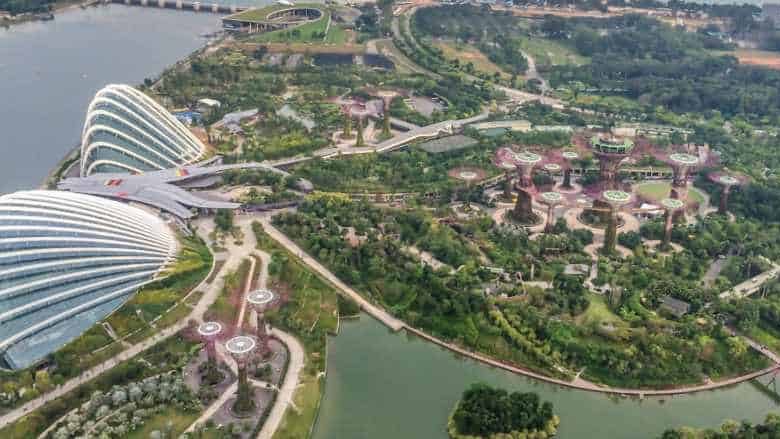
Singapore, one of the most advanced island cities, exemplifies how long-term planning and investment in climate resilience can yield tangible results. Anticipating worst-case climate scenarios, Singapore has committed $100 billion toward climate adaptation strategies, including flood mitigation and urban heat reduction.
Singapore’s approach is comprehensive. The city-state has long embraced sustainable urban design, requiring new buildings to integrate greenery and meet zero-energy standards. Land reclamation, smart infrastructure, and digitalization efforts drive economic growth while minimizing emissions. Unlike many other island nations, Singapore is not waiting for external support—it is investing in itself, securing its future through bold policies and technological innovation.
Jakarta: A City Sinking Under the Weight of Development
In stark contrast, Jakarta—one of Southeast Asia’s most populous island cities—is facing a climate crisis exacerbated by poor urban planning and unsustainable development. Rapid urbanization, deforestation, and inadequate waste management have turned Jakarta into one of the world’s fastest-sinking cities. Today, two-fifths of the metropolis sits below sea level, with flooding becoming an increasingly severe and frequent threat.
The Indonesian government’s response? Moving the capital. The decision to relocate Indonesia’s administrative hub to Nusantara, on the island of Borneo, is meant to alleviate Jakarta’s congestion and environmental degradation. However, it raises pressing concerns: How will the new city be built sustainably? And what happens to the millions left behind in a sinking Jakarta?
Two Cities, Two Realities
Singapore and Jakarta illustrate the stark disparities within island nations of the Global South. While Singapore exemplifies a proactive, well-resourced model of climate resilience, Jakarta reflects the struggles of a rapidly urbanizing island city trapped in a cycle of poor planning and vulnerability.
Despite their differences, both cities highlight a crucial reality: urban resilience requires a convergence of social, economic, and environmental strategies. Without integrated preparedness, cities risk being overwhelmed by the challenges ahead. But resilience is not just a local issue—it demands global cooperation. Island nations need stronger international support, equitable climate finance, and technological partnerships to safeguard their urban futures.
For island cities, the race against climate change is more than a policy debate. It is a fight for survival, a fight they cannot afford to lose.
source :
https://www.urbanet.info/island-states-global-south-urban-climate-resilience/