Living bricks turning cities into green air filters
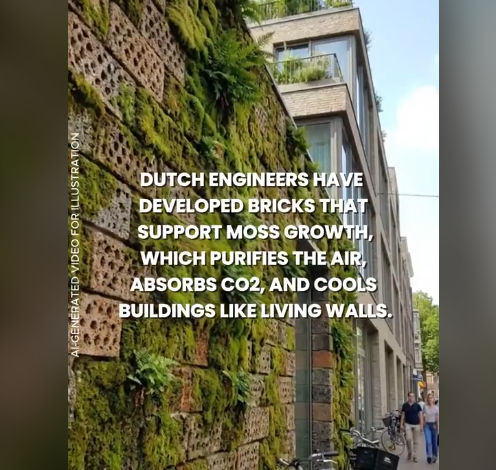
Living Bricks: How Moss-Covered Walls Could Help Cities Fight Heat and Pollution
What if the walls of our buildings could do more than provide shelter?
What if they could also support vegetation, retain rainwater, help cool urban spaces, and contribute to healthier city environments?
Engineers in the Netherlands are exploring this idea through bio-receptive, moss-growing bricks—building materials designed to provide a suitable surface for moss and other small forms of vegetation to establish naturally.
The concept represents an interesting shift in sustainable architecture: instead of treating buildings as separate from nature, why not design buildings that can work with nature?
From Building Material to Living Surface
Conventional bricks and concrete are generally designed to be durable, stable, and resistant to biological growth. Bio-receptive materials take the opposite approach.
Their surfaces can be designed with characteristics such as porosity, texture, moisture retention, and suitable micro-environments that make it easier for moss to grow.
Once established, moss becomes part of the building’s living surface.
Rather than requiring conventional landscaping space, vegetation can occupy vertical surfaces that already exist throughout cities.
Can Moss Help Clean Urban Air?
Moss and other plants naturally interact with the atmosphere.
Through photosynthesis, vegetation takes in carbon dioxide and releases oxygen. Moss surfaces can also capture or retain some particulate matter and contribute to local air-quality processes.
However, it is important not to overstate the effect. A moss-covered wall is not a replacement for urban forests, emission controls, or effective air-quality policies.
Its value lies in the cumulative effect of integrating more living surfaces into densely built environments.
Imagine thousands of walls, façades, and other structures incorporating vegetation. Individually, each surface may have a modest effect. Collectively, however, green infrastructure can become part of a broader urban climate strategy.
A Natural Approach to Urban Heat
One of the most promising aspects of living walls is their relationship with urban heat.
Concrete, asphalt, and other hard surfaces absorb and store solar heat. In densely developed areas, this contributes to the urban heat island effect, where cities can become considerably warmer than surrounding areas.
Vegetated surfaces can help moderate temperatures through shading, moisture retention, and evapotranspiration. As water evaporates, heat is removed from the surrounding environment, helping vegetation and surfaces remain cooler.
For buildings, this could potentially contribute to reduced heat stress and improved outdoor microclimates, although the actual performance depends on factors such as climate, wall orientation, moisture availability, vegetation coverage, and building design.
Turning Walls into Part of the Water Cycle
Living surfaces can also play a role in urban water management.
Moss and other vegetation can retain some rainfall, slowing the movement of water across hard surfaces. In combination with green roofs, rain gardens, permeable pavements, and urban trees, this approach can contribute to reducing stormwater runoff.
This becomes increasingly relevant as cities face heavier rainfall events and growing pressure on drainage infrastructure.
Small Habitats in a Concrete Landscape
A moss-covered wall may appear simple, but it can create a small ecological niche.
Moss can provide habitat and moisture for microorganisms and small invertebrates. When combined with other forms of urban greenery, these microhabitats can contribute to greater urban biodiversity.
This is particularly important in cities where natural habitats have been fragmented by roads, buildings, and other infrastructure.
Rethinking What a Building Can Do
The bigger idea behind moss-growing bricks is not simply about replacing conventional bricks.
It is about changing our understanding of infrastructure.
Traditionally, we design cities to control nature:
Concrete walls keep nature out.
Drainage systems move water away.
Buildings protect us from the climate.
But climate change is forcing cities to reconsider this relationship.
What if some infrastructure could instead work with natural processes?
Buildings could provide surfaces for vegetation. Roofs could retain rainwater. Streets could absorb rainfall. Trees could provide shade. Wetlands could protect urban areas from flooding.
Together, these approaches form part of what is broadly known as nature-based solutions and green infrastructure.
The Future May Not Be Grey
Moss-growing bricks will not solve urban pollution or climate change on their own. Cities still need cleaner transportation, renewable energy, efficient buildings, better waste management, urban forests, and strong environmental policies.
But the concept offers an important lesson:
Sustainability does not always mean building something completely new. Sometimes it means redesigning what already surrounds us.
A wall can be more than a wall.
A roof can be more than a roof.
And a city can be more than concrete and asphalt.
The future of sustainable construction may increasingly be about creating buildings that provide services to people and nature at the same time.
Because perhaps the cities of tomorrow should not simply be places where nature survives.
source: