Nature based carbon credits project
Investing in Ecosystems That Protect Both Climate and Communities
“The most valuable carbon technology may not be built in a factory. It may already exist in a forest, a mangrove, a peatland, or beneath our feet.”
As the world accelerates its transition toward a low-carbon economy, carbon markets are becoming an increasingly important mechanism for financing climate action. Yet not all carbon credits are created in the same way. Among the fastest-growing segments of the voluntary carbon market are nature-based carbon credits—projects that harness the power of natural ecosystems to remove, store, or prevent greenhouse gas emissions while delivering benefits that extend far beyond carbon. Unlike many engineered climate solutions, nature-based projects work with ecological processes that have evolved over millions of years. Healthy forests, wetlands, mangroves, grasslands, and agricultural soils continuously capture and store carbon while simultaneously supporting biodiversity, regulating water cycles, protecting coastlines, and sustaining local livelihoods. In other words, they address multiple environmental and social challenges through a single investment.
More Than Carbon Storage
Carbon is often the headline metric because it can be measured, verified, and traded. However, the true value of nature-based projects lies in the wide range of ecosystem services they provide. A restored forest does more than absorb atmospheric carbon dioxide. It stabilizes soils, reduces erosion, regulates local rainfall, protects watersheds, creates wildlife habitat, and supports communities that depend on forest resources for food, income, and cultural identity. Similarly, restoring a mangrove forest does far more than generate carbon credits. It strengthens coastal resilience against storms, provides nursery grounds for fisheries, improves water quality, conserves biodiversity, and helps safeguard livelihoods in vulnerable coastal communities. Nature-based carbon projects therefore represent an investment not only in climate mitigation, but also in ecological resilience and sustainable development.
The Diversity of Nature-Based Carbon Projects
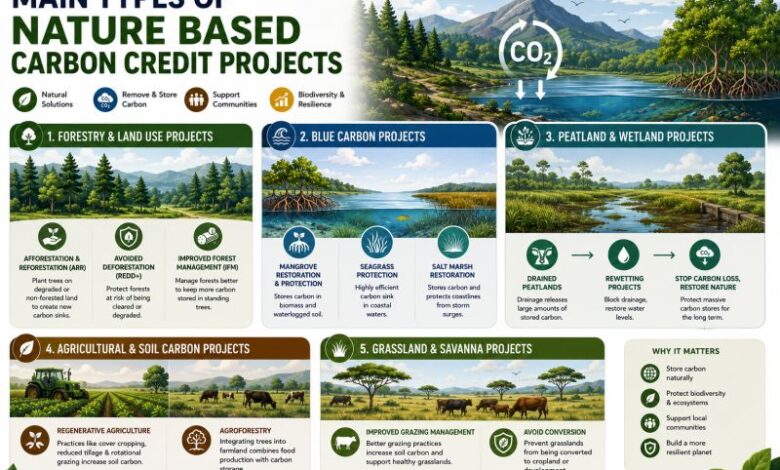
Nature-based carbon credits encompass a broad range of ecosystem restoration and conservation activities, each contributing to climate action in different ways.
Forestry and Land Use Projects
Forests remain one of the planet’s most effective natural carbon sinks. Projects such as afforestation, reforestation, Improved Forest Management (IFM), and Reducing Emissions from Deforestation and Forest Degradation (REDD+) aim to increase carbon sequestration while conserving some of the world’s most biologically diverse ecosystems. Beyond climate benefits, these projects protect watersheds, reduce habitat fragmentation, conserve endangered species, and often provide sustainable income opportunities for Indigenous Peoples and local communities whose stewardship is essential for long-term forest conservation.
Blue Carbon Projects
Coastal ecosystems including mangrove forests, seagrass meadows, and salt marshes are among the most efficient carbon sinks on Earth. Although they occupy only a small fraction of the planet’s surface, these ecosystems can store carbon at rates significantly higher than many terrestrial forests, particularly within their waterlogged soils. Blue carbon projects also provide natural coastal defenses against storm surges, reduce erosion, improve fisheries productivity, support marine biodiversity, and enhance the resilience of coastal communities facing rising sea levels and stronger tropical storms.
Peatland and Wetland Projects
Peatlands store immense quantities of carbon accumulated over thousands of years. When drained, degraded, or burned, they rapidly release this stored carbon into the atmosphere, becoming major sources of greenhouse gas emissions. Restoring peatlands by rewetting and protecting these ecosystems prevents further emissions while rebuilding biodiversity, improving water regulation, reducing wildfire risks, and preserving globally significant carbon stocks. Wetland restoration similarly contributes to flood mitigation, water purification, and habitat conservation.
Agricultural and Soil Carbon Projects
Healthy soils are among the world’s largest terrestrial carbon reservoirs. Agricultural projects promote practices such as regenerative farming, cover cropping, reduced tillage, rotational grazing, agroforestry, and improved nutrient management to increase soil organic carbon while enhancing farm productivity. These approaches improve soil fertility, increase water retention, reduce erosion, strengthen resilience to drought, and support long-term food security demonstrating that productive agriculture and climate action can advance together.
Grassland and Savanna Projects
Grasslands and savannas are frequently overlooked in climate discussions, despite storing substantial amounts of carbon below ground. Projects that improve grazing management, restore degraded grasslands, and prevent land conversion help maintain these carbon reservoirs while supporting biodiversity, improving ecosystem resilience, and sustaining pastoral livelihoods. Healthy grasslands also reduce desertification risks and enhance the resilience of dryland ecosystems under a changing climate.
Carbon Credits Are Only as Strong as Their Integrity
As demand for carbon credits continues to grow, attention is increasingly shifting from the quantity of credits generated to their environmental integrity. High-quality nature-based carbon projects should demonstrate that emissions reductions or carbon removals are additional meaning they would not have occurred without the project. They should ensure permanence, reducing the risk that stored carbon will later be released through deforestation, wildfire, or land-use change. They must address leakage, ensuring that protecting one area does not simply shift environmental degradation elsewhere. Equally important, projects should be independently monitored, transparently verified, and developed with the Free, Prior and Informed Consent (FPIC) of Indigenous Peoples and local communities wherever applicable. Strong governance, scientific monitoring, and community participation are fundamental to maintaining trust in carbon markets.
Nature-Based Solutions Deliver Multiple Benefits
One of the greatest strengths of nature-based carbon projects is that they generate benefits extending far beyond emissions reductions.
When well designed, they can:
- Protect biodiversity and restore degraded ecosystems.
- Improve watershed health and water security.
- Reduce flood, erosion, and wildfire risks.
- Support sustainable agriculture and fisheries.
- Strengthen climate adaptation and disaster resilience.
- Create employment and diversify rural livelihoods.
- Enhance the well-being of Indigenous Peoples and local communities.
- Contribute to multiple United Nations Sustainable Development Goals (SDGs) simultaneously.
This integrated value proposition explains why governments, investors, corporations, and development institutions increasingly view nature-based solutions as essential components of climate strategies.
Why Businesses Should Pay Attention
For businesses, nature-based carbon credits are no longer simply a voluntary environmental initiative. They are becoming part of broader climate transition strategies, biodiversity commitments, supply chain resilience, and ESG performance. Organizations with credible net-zero pathways increasingly recognize that carbon credits should complement not replace deep emissions reductions within their own operations and value chains. High-integrity nature-based projects can help address residual emissions while contributing to broader environmental and social outcomes that stakeholders increasingly expect. However, companies must exercise due diligence, selecting projects that are scientifically robust, socially responsible, and transparently governed to minimize reputational and environmental risks.
Investing in Nature Means Investing in the Future
Climate change, biodiversity loss, land degradation, and water insecurity are often discussed as separate global crises. In reality, they are deeply interconnected. Nature-based carbon projects demonstrate that restoring ecosystems can simultaneously remove carbon from the atmosphere, strengthen biodiversity, improve livelihoods, and increase resilience to climate change. They remind us that forests are more than timber. Mangroves are more than coastlines. Wetlands are more than swamps. Healthy soils are more than farmland. These ecosystems are living infrastructure that supports economies, communities, and the stability of the Earth’s climate. As carbon markets continue to evolve, the greatest opportunity lies not simply in generating more carbon credits, but in financing projects that create lasting environmental and social value.
source: