Planning Cities For Pandemics: A Review of Urban and Transport Planning Lessons From COVID-19
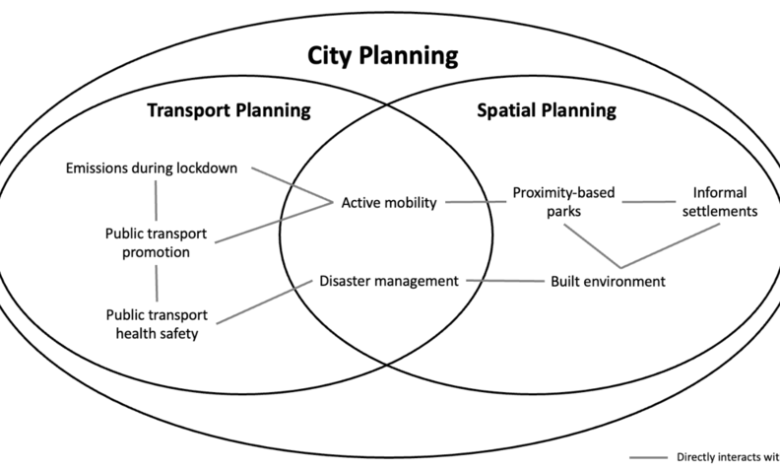
On the last day of 2019, with the New Year’s celebrations underway, a cluster of pneumonia cases of unknown causes was reported from Wuhan, Hubei province, China (WHO, 2020). From that moment, societies faced one of the worst pandemics of modern times. From all over the world and in different areas of knowledge, researchers started looking for solutions to reduce the spread of contagion while trying to adapt an unaware and unprepared society to a global pandemic. Urban areas become the centre of most outbreaks during these two years (Acuto, 2020): with over half of the world’s population living in urban areas, most of which easily connect within each other and with each other (UN, 2018), cities became the main areas of concern for the rapid spread of the virus. This pandemic has impacted, arguably forever, our cities, as other pandemics in the past did (Eltarabily and Elgheznawy, 2020). Because spatial and transport planning certainly influences the spread of a virus in the urban environment, in the future, they must become part of short- and long-term solutions to other outbreaks of infectious diseases. COVID-19 first caught the attention of urban and transport planners when a lockdown was declared in the city of Wuhan on January 23, 2020. Words such as social distancing and self-isolation started echoing worldwide at a stage where urban and transport planning was heading in a different, almost opposite direction; cities becoming denser, more compact and promoting transport planning policies aiming for higher public transport mobility and overall mass use. Inevitably, this led to an enormous COVID-19 impact on cities, as recognised by Krishna and Kummitha (2020). Cities thus face the daunting tasks of mitigating COVID-19 impacts, and spatial and transport planning are becoming frontrunners in this quest, as argued by Ibert et al. (2022) and, Tešić and Lukić (2020). This article aims to review the state-of-the-art of research produced in spatial and transport planning concerning COVID-19, from its inception to the present, to summarise and analyse the main conclusions, and to suggest new avenues of research on the relationships between the urban layout, accessibility, mobility and the spread of a virus in an urban environment. The motivation for writing this review was to systematise the knowledge in the field, contributing by creating a coherent overview of the research landscape, filling a literature gap on reviews of COVID-19 impacts on municipal engineering. Furthermore, it suggests future research lines which, as will be seen, cater for pandemics but also connect that aspect with other essential aspects of the urban environment, society, and sustainability. The following two chapters highlight the core role that both spatial and transport planning have during pandemic times and how COVID-19 might redirect research and change policies and practice in the short- and long term.
source :