The many colors of Carbon
The Carbon Mosaic: Decoding the Spectrum of Climate Action
Carbon is often discussed as a monolithic enemy, but in reality, it is a complex spectrum. To achieve true Net-Zero, we must move beyond treating carbon as a single variable and instead address it as a mosaic of different “colors.” Each color represents a unique chemical behavior, environmental impact, and strategic opportunity.
1. The Warming Agents (The “Heating” Spectrum)
These forms of carbon are active drivers of atmospheric warming and require immediate mitigation to slow the pace of climate change.
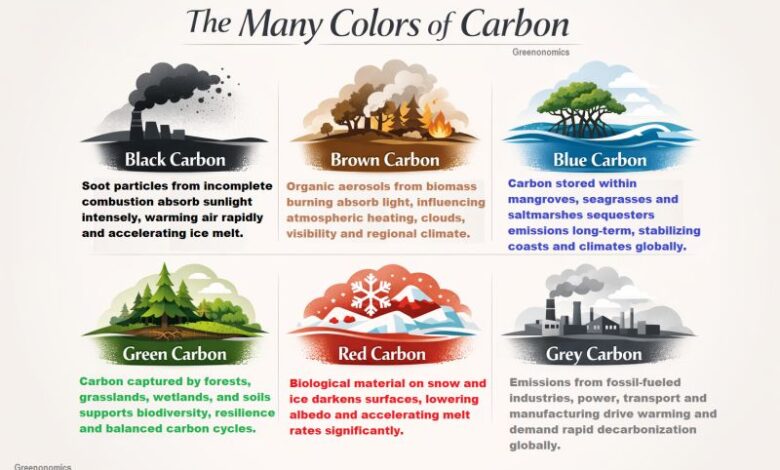
- Black Carbon (Soot): A byproduct of incomplete combustion (diesel engines, cookstoves). Unlike CO2, it is short-lived but thousands of times more potent at trapping heat. When it settles on glaciers, it darkens the surface, absorbing solar energy and accelerating ice melt.
- Strategic Win: Rapid reduction provides almost instant cooling effects and massive public health benefits.
- Brown Carbon: Released primarily through biomass burning (wildfires and agricultural clearing). It sits between black and green carbon, influencing cloud formation and regional weather patterns.
- Red Carbon: The “biological accelerator.” This refers to algae and microbes that bloom on snow and ice. By darkening the cryosphere, they trigger a feedback loop of rapid melting that is often underrepresented in climate models.
2. The Legacy Emissions (The “Industrial” Challenge)
- Grey Carbon: This represents the “old guard” emissions from fossil fuel combustion (coal, oil, and gas). It remains the largest contributor to the greenhouse effect and the primary target of global decarbonization and the transition to renewable energy.
3. The Natural Sinks (The “Cooling” Solutions)
Nature-based solutions are our most effective carbon “vaults,” providing long-term storage while supporting ecosystems.
- Blue Carbon (The Marine Vault): Carbon captured by ocean and coastal ecosystems mangroves, seagrasses, and salt marshes. These habitats can store up to 10 times more carbon per acre than terrestrial forests and act as vital storm surges for coastal protection.
- Green Carbon (The Terrestrial Sponge): Carbon sequestered by the “living world” forests, grasslands, and soil. Beyond mitigation, green carbon promotes biodiversity, stabilizes local water cycles, and ensures food security through healthy soil.
Comparative Strategy Matrix
| Color | Source/Origin | Climate Impact | Strategic Priority |
| Black/Brown | Combustion/Biomass | Short-term, high intensity | Immediate reduction for fast climate “wins.” |
| Grey | Fossil Fuels | Long-term atmospheric warming | Systemic decarbonization and energy shift. |
| Blue/Green | Natural Ecosystems | Sequestration & Resilience | Aggressive protection and restoration. |
| Red | Biological Feedbacks | Cryosphere (Ice) Loss | Monitoring & specialized mitigation of warming. |
The Synthesis: A Multi-Dimensional Climate Strategy
Effective climate policy is no longer just about “lowering a number.” It is about a color-coded precision approach:
- Stop the Soot: Aggressive filtration and clean-cooking initiatives to tackle Black Carbon for immediate health and cooling results.
- Protect the Vaults: Prioritizing Blue Carbon is the highest-leverage nature-based investment we can make for long-term storage.
- Modernize the Grid: Transitioning from Grey Carbon to renewables remains the non-negotiable foundation of the Paris Agreement.
- Manage the Feedbacks: Understanding Red and Brown carbon allows us to predict and mitigate “tipping points” in the Arctic and rainforests.
The Bottom Line: We cannot solve a multi-colored problem with a monochrome solution. By addressing the full spectrum of carbon, we make climate action smarter, faster, and more resilient.
source: