The most efficient vehicle is a street: why the future of mobility begins with better urban planning
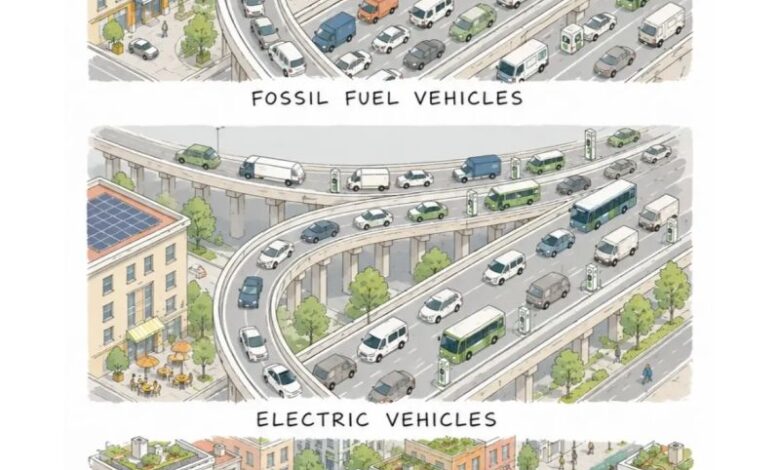
“A sustainable city is not one where everyone drives an electric car. It is one where many trips don’t require a car at all.”
For decades, the debate about sustainable transportation has centered on one question:
How do we replace gasoline-powered cars?
The answer has largely been electric vehicles (EVs). By eliminating tailpipe emissions and improving energy efficiency, EVs are undoubtedly a critical part of the global transition toward a low-carbon economy. Governments are investing billions in charging infrastructure, automakers are electrifying their fleets, and consumers are increasingly embracing cleaner mobility.
But electrification, while essential, addresses only one part of a much larger challenge.
The greatest transportation problem facing modern cities is not simply what powers our vehicles—it is how our cities are designed.
The Hidden Cost of Car-Dependent Cities
Cars have shaped urban development for nearly a century. Roads widened, parking lots expanded, highways cut through neighborhoods, and cities stretched farther outward. This model enabled unprecedented mobility, but it also created unintended consequences that continue to define urban life today.
Car-dependent cities consume enormous amounts of land for roads, parking facilities, and supporting infrastructure. They encourage urban sprawl, lengthen commuting distances, increase infrastructure costs, and make daily life dependent on private vehicles.
The consequences extend far beyond traffic congestion.
Heavy reliance on private cars contributes to air pollution, greenhouse gas emissions, traffic fatalities, noise pollution, sedentary lifestyles, and unequal access to opportunities for people who cannot afford or operate a vehicle.
Even if every car on the road became electric tomorrow, many of these challenges would remain.
Electric Vehicles Solve One Problem—Not All of Them
Electric vehicles represent a major environmental improvement over conventional internal combustion engines. They reduce tailpipe emissions, improve urban air quality, and can significantly lower lifecycle emissions when powered by renewable electricity.
However, replacing every gasoline car with an electric one does not eliminate congestion.
It does not reduce the amount of urban land devoted to roads and parking.
It does not solve traffic delays.
It does not eliminate the demand for steel, aluminum, concrete, lithium, nickel, cobalt, or other critical minerals required for vehicle production.
Most importantly, it does not change a transportation system that often requires people to drive for nearly every aspect of daily life.
In other words, EVs solve an energy problem, but they do not automatically solve a city design problem.
Streets Are More Than Roads
One of the most overlooked ideas in urban planning is that a street is not merely a corridor for moving vehicles.
A well-designed street is public infrastructure that connects people to jobs, schools, healthcare, parks, businesses, and one another.
When streets prioritize multiple forms of mobility rather than private automobiles alone, they become engines of economic activity, social interaction, and environmental sustainability.
Protected sidewalks encourage walking.
Dedicated cycling infrastructure makes short trips faster and safer.
Reliable public transportation moves large numbers of people efficiently while reducing congestion and emissions.
Trees, public spaces, and mixed-use neighborhoods transform streets from traffic corridors into places where communities thrive.
The most efficient street is not the one carrying the greatest number of cars.
It is the one moving the greatest number of people while creating the highest quality of urban life.
Moving More People, Not More Vehicles
Transportation efficiency is often misunderstood.
Adding more traffic lanes may temporarily increase road capacity, but it frequently induces additional traffic over time as more people choose to drive—a phenomenon known as induced demand.
By contrast, investments in active mobility and public transportation allow cities to move significantly more people using less space and energy.
A single tram or metro line can transport thousands of passengers every hour using only a fraction of the space required by private vehicles.
Protected bicycle lanes can carry more travelers per meter of street width than multiple traffic lanes while producing virtually no direct emissions.
Walkable neighborhoods reduce the need for motorized travel altogether by placing housing, employment, education, shopping, and recreation within convenient distances.
The most sustainable trip is often the one that never requires a vehicle.
The Mobility Hierarchy
Rather than viewing transportation modes as competitors, many urban planners now advocate a mobility hierarchy that prioritizes the most efficient and sustainable options first.
The hierarchy is simple:
- Walk whenever possible, because walking requires no fuel, produces no emissions, and promotes physical and mental health.
- Cycle for short and medium-distance trips, providing fast, affordable, and low-carbon mobility while requiring minimal infrastructure.
- Use public transportation for longer journeys, maximizing passenger capacity while reducing congestion and energy use.
- Reserve motor vehicles—including electric vehicles—for trips where they are genuinely necessary, such as freight movement, emergency services, accessibility needs, or locations without viable alternatives.
This approach recognizes that every transportation mode has a role—but not every trip requires a private car.
Designing Cities Around People
Around the world, cities that prioritize people rather than traffic are already demonstrating what is possible.
Investments in pedestrian-friendly streets, cycling networks, integrated public transportation, and transit-oriented development have reduced emissions while improving public health, economic vitality, and social inclusion.
Local businesses benefit from increased foot traffic.
Residents spend less time commuting and more time with their families.
Healthcare costs decline as active transportation increases physical activity.
Public spaces become safer and more vibrant.
Environmental benefits extend beyond transportation, with reduced noise pollution, lower urban heat island effects, and improved air quality contributing to healthier, more resilient communities.
The Future of Mobility Is Urban Design
The future of transportation is not a competition between electric vehicles, bicycles, buses, trains, or walking.
It is about integrating these modes into cities designed around human needs rather than automobile convenience.
Technology will continue to improve vehicles.
But only thoughtful urban planning can reduce the need for unnecessary travel, shorten daily journeys, and create communities where sustainable choices become the easiest choices.
The ultimate goal is not to replace every gasoline car with an electric one.
It is to build cities where owning a car is an option—not a necessity.
Because the most efficient vehicle may not be a vehicle at all.
It may be a well-designed street that allows people to safely walk, comfortably cycle, and conveniently access public transportation.
The cleanest kilometer is the one that never needs to be driven.
And the smartest city is not the one with the widest roads—
it is the one that gives people the freedom to move without depending on a car.
source: