Understanding the Sustainable Development Goals (SDGs) and Doughnut Economics
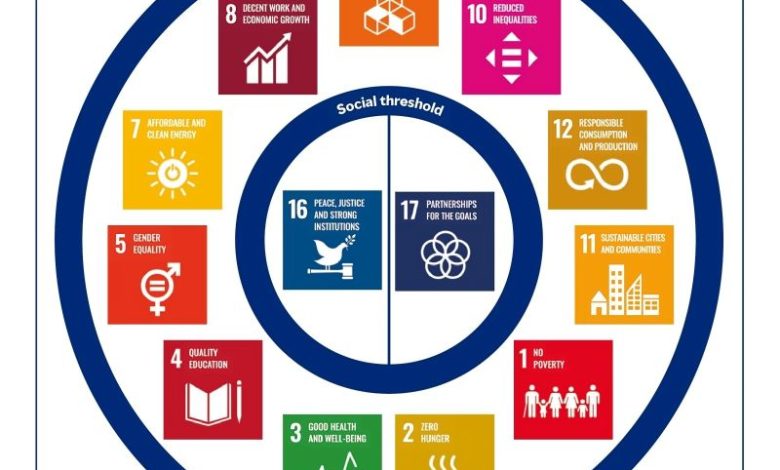
The Sustainable Development Goals (SDGs) are an interconnected framework aimed at addressing global challenges such as poverty, inequality, and environmental degradation. When viewed as parts of a complex network rather than isolated objectives, the SDGs enable a more nuanced and effective approach to sustainable development.
Doughnut Economics: This concept, introduced by economist Kate Raworth, provides a visual framework for sustainable development by balancing human needs and environmental sustainability. The model is shaped like a doughnut with two concentric rings:
- Social Foundation (Inner Ring): Represents the minimum standards required for a dignified life, including access to essentials such as healthcare, education, and housing. Failing to meet these needs leads to critical human deprivations.
- Ecological Ceiling (Outer Ring): Represents the planetary boundaries within which humanity must operate to avoid environmental degradation and ensure Earth’s long-term health. Crossing these boundaries leads to critical ecological overshoot.
The Doughnut Model and SDGs:
- Social SDGs: These goals focus on eradicating poverty, achieving quality education, ensuring good health and well-being, and promoting gender equality. These goals align with the social foundation of the Doughnut model, emphasizing the need to elevate the quality of life for all individuals without compromising their basic rights and needs.
- Environmental SDGs: Goals such as climate action, life below water, life on land, and responsible consumption and production align with the ecological ceiling of the Doughnut model. These goals emphasize the importance of maintaining a balance between resource use and environmental sustainability.
Integrating Doughnut Economics and SDGs: Applying Doughnut Economics to the SDGs encourages the development of policies that are mindful of both ecological limits and social imperatives. This integrated approach helps in crafting multi-dimensional strategies that consider the interdependencies among different goals.
- Balanced Policies: Policies influenced by Doughnut Economics avoid the pitfalls of focusing on single issues in isolation. Instead, they embrace holistic solutions that acknowledge the interconnected nature of social and environmental goals. For example, a policy aimed at improving agricultural productivity must also consider its impact on water resources, biodiversity, and social equity.
- Ripple Effects: Recognizing the ripple effects across the spectrum of development goals leads to more comprehensive and sustainable outcomes. For instance, improving access to clean energy (SDG 7) can have positive impacts on health (SDG 3), economic growth (SDG 8), and climate action (SDG 13).
Practical Implications: Doughnut Economics provides a pragmatic framework for aligning the SDGs in real-world decision-making. It serves as a guide for policymakers, businesses, and civil society to design and implement actions that balance human development with ecological sustainability.
- Decision-Making: By using the Doughnut model, decision-makers can evaluate whether proposed actions will help achieve a balanced state where social foundations are met without breaching ecological ceilings. This ensures that development is sustainable and inclusive.
- Holistic Development: The framework supports the creation of policies that are both environmentally sustainable and socially equitable. This approach helps in addressing the root causes of issues rather than just their symptoms, leading to long-term solutions that benefit both people and the planet.
In summary, understanding the SDGs through the lens of Doughnut Economics offers a comprehensive approach to sustainable development. It emphasizes the need to balance human progress with environmental stewardship, ensuring that development efforts are both equitable and ecologically sustainable.
source :