What is sustainability?
Sustainable Growth: From Vision to Action
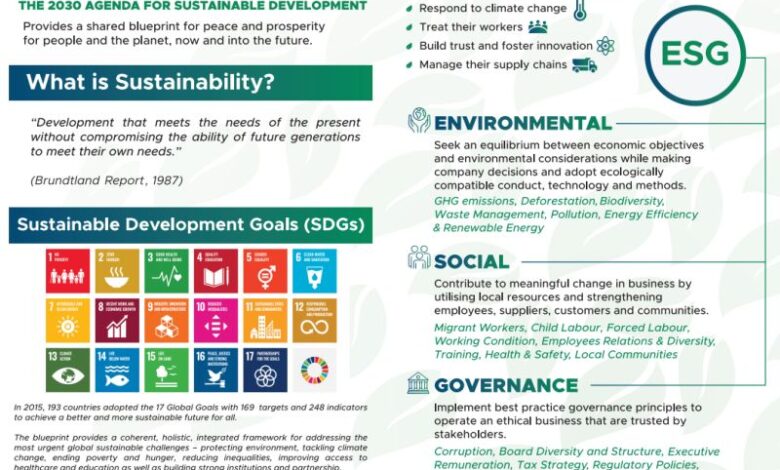
To understand how sustainability, the SDGs, and ESG connect, think of them as a layered approach to responsible growth. Sustainability is the foundational vision, the core principle of living within our means. The Sustainable Development Goals (SDGs) are the global blueprint, translating that vision into a set of shared, actionable goals. ESG (Environmental, Social, and Governance) is the practical framework that businesses and investors use to measure and manage their contribution to those goals.
The Core Concepts
- Sustainability: It’s a timeless concept, defined in the 1987 Brundtland Report as “meeting the needs of the present without compromising the ability of future generations to meet their own needs.” It’s about maintaining a balance between ecological limits and human needs. This holistic idea is the “why” behind all sustainable efforts.
- SDGs (Sustainable Development Goals): Adopted by 193 countries, the SDGs are a set of 17 interconnected goals with 169 specific targets. They provide a universal roadmap for tackling global challenges like poverty, hunger, climate change, and inequality. Think of them as the global agenda for sustainability, providing a common language and a clear direction for governments and organizations worldwide.
- ESG (Environmental, Social, and Governance): This framework is how organizations bring sustainability and the SDGs into their daily operations. It’s the “how” for business.
- Environmental: This includes a company’s impact on the planet, such as its carbon emissions, waste management, and resource use.
- Social: This focuses on a company’s relationships with people, including employees, suppliers, customers, and the communities it operates in. Fair labor practices and human rights are key here.
- Governance: This pillar is about how a company is run. It includes things like leadership structure, executive pay, and shareholder rights. Strong governance builds trust and ensures accountability.
How They Fit Together
The relationship among these three concepts is synergistic. Sustainability provides the overarching philosophy. The SDGs give us a shared global playbook of what needs to be done. ESG provides the specific metrics and actions for businesses to play their part in that playbook.
For example, an organization aiming to be sustainable might use the ESG framework to address specific SDG targets. To address SDG 7 (Affordable and Clean Energy), a company could focus on the “E” in ESG by investing in renewable energy and improving energy efficiency. To address SDG 5 (Gender Equality), a company could focus on the “S” by implementing fair hiring practices and promoting women to leadership roles. To address SDG 16 (Peace, Justice, and Strong Institutions), a company could focus on the “G” by strengthening its corporate governance and anti-corruption policies.
In essence, this alignment creates a powerful loop: the vision of sustainability is given a clear global direction by the SDGs, and this direction is made measurable and actionable for businesses through ESG. This integrated approach is essential for turning ambitious goals into tangible, responsible, and inclusive growth.
source: