When cities grow their own food
The Rise of the Edible Skyline: Architecture as an Autotroph
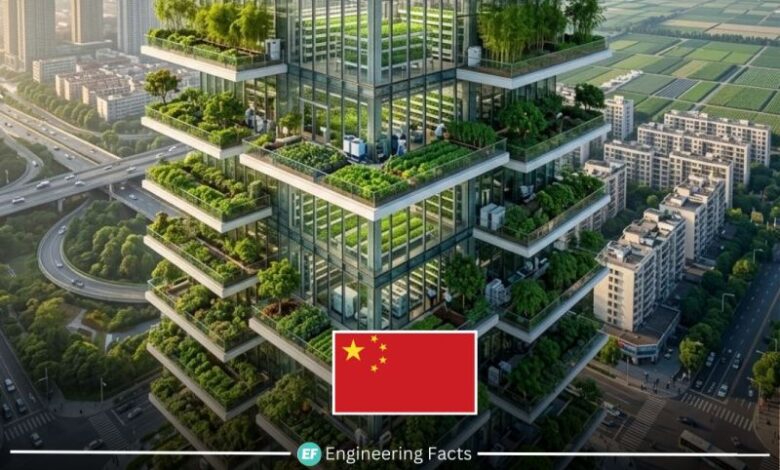
For centuries, the city has been a parasite consuming vast resources from the countryside and returning only waste. But a radical shift in China is turning the urban fabric into a producer. A 1,000-acre vertical farming “City-within-a-City” is proving that the future of food isn’t horizontal; it’s perpendicular.
This is the dawn of Metabolic Urbanism, where skyscrapers don’t just house people they feed them.
The Efficiency of Verticality: 9x Output, 90% Less Waste
Traditional agriculture is a gamble against the elements. Vertical farming is a mastery of variables. By stacking layers of life, these urban monoliths achieve what was once mathematically impossible:
- Spatial Hyper-Efficiency: Producing 9x more food per acre by utilizing the Z-axis.
- Hydro-Frugality: Operating on 90% less water through closed-loop hydroponic circuits that recapture every drop of transpiration.
- Weather Independence: A “Climate-Proof” harvest. Advanced sensors create a perpetual spring, shielding crops from the droughts and floods that are crippling traditional breadbaskets.
The “Zero-Mile” Diet: Decarbonizing the Plate
The hidden cost of your salad isn’t just the water; it’s the logistics. Most produce travels 1,500 miles before it reaches a fork. Vertical farming deletes the middleman.
- Eliminating the Cold Chain: By growing food where people live, we remove the need for long-haul trucking and massive refrigeration energy.
- Freshness as a Metric: Nutrient density in produce degrades every hour after harvest. Urban farms deliver “minutes-old” produce, maximizing public health.
- Urban Sequestration: These “Green Cities” act as giant carbon scrubbers, utilizing the CO2 exhaled by residents to accelerate plant growth.
Strategic Shift: Traditional vs. Vertical Urban Agriculture
| Factor | Industrial Agriculture (Rural) | Vertical Farming (Urban) |
| Water Usage | High (Evaporation/Runoff) | Ultra-Low (Recirculated) |
| Land Footprint | Massive (Horizontal) | Minimal (Vertical) |
| Pesticide Need | High (External Pathogens) | Zero (Controlled Environment) |
| Supply Chain | Complex & High Carbon | “Zero-Mile” & Low Carbon |
The Executive Summary: The City as an Ecosystem
The “Green City” of 2026 is no longer defined by decorative parks; it is defined by productive ecosystems.
By integrating 1,000-acre vertical farms into the urban core, we are solving the Urban-Food Paradox. We are reducing the pressure on our wild forests, restoring our depleted aquifers, and ensuring that even in a climate-volatile world, the city remains a place of abundance. The farm of the future doesn’t have a fence; it has a lobby.