
The circular economy Iceberg
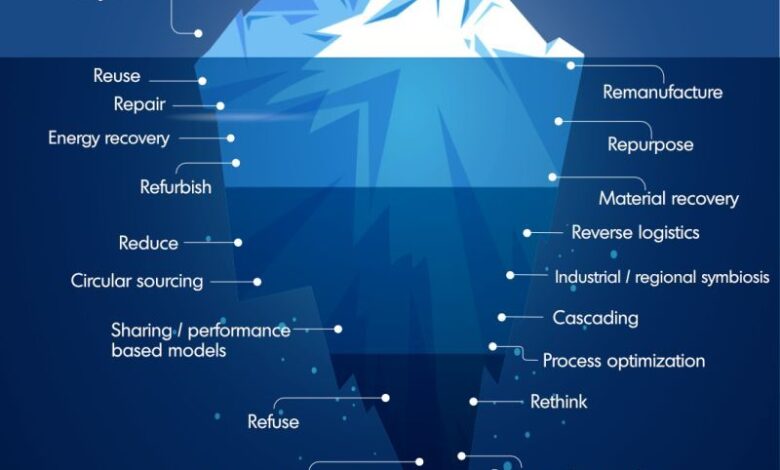
In global sustainability discourse, the circular economy is frequently oversimplified and reduced to a single downstream activity: recycling. In reality, recycling represents only the visible tip of a much larger industrial and economic paradigm.
True circularity is a comprehensive, systemic framework that begins at the pre-production phase through intentional design, material selection, and business model innovation. When implemented strategically, it functions as a core driver for corporate procurement, value-chain optimization, and ecosystem regeneration preventing waste before it enters the economic lifecycle.
1. Structural Breakdown: The Tiers of Circular Strategy
To capture the full spectrum of circular economics, the system can be divided into three operational layers, moving from the downstream (least impactful) to the upstream (most impactful).
                      ▲
                     / \         ⚠️ THE TIP: Recycling & Waste Management
                    / R \          (High energy input, late lifecycle intervention)
                   /─────\
                  /       \      ⚙️ THE MIDDLE: Product Lifetime Extension
                 /  REPAIR \       (Repair, Reuse, Refurbishment, Remanufacturing)
                / REPURPOSE \
               /─────────────\
              /    DESIGN     \  💎 THE BASE: Systemic Prevention & Regeneration
             /   BUSINESS MOD  \   (Designing out waste, Sharing models, Regeneration)
            /───────────────────\
Tier 1: The Visible Tip (End-of-Life Recovery)
- Mechanisms: Mechanical recycling, chemical recycling, and downcycling.
- The Structural Flaw: This stage represents a late-lifecycle intervention. It requires significant energy inputs to break down degraded materials and fails to address the resource inefficiencies embedded during initial manufacturing.
Tier 2: The Mid-Surface (Product Lifetime Extension)
- Mechanisms: Repair, reuse, refurbishment, remanufacturing, and reverse logistics.
- The Structural Flaw: Keeps existing products at their highest utility and value for as long as possible, significantly delaying the need for raw material extraction and end-of-life disposal.
Tier 3: The Sub-Surface Foundation (Systemic Prevention)
- Mechanisms: Designing out waste entirely, shifting from ownership to Access-as-a-Service (sharing models), and implementing regenerative sourcing.
- The Structural Flaw: The most powerful tier. It re-engineers the industrial process so that waste ceases to exist as a concept, decoupling economic growth from finite resource consumption.
2. Strategic Matrix: Moving Beyond Waste Management
For cross-functional leadership, transitioning from a recycling-centric mindset to full systemic circularity alters operations across four key corporate agendas:
| Corporate Agenda | Traditional Linear/Recycling Mindset | Advanced Circular Economy Paradigm |
| Product Design | Designing for assembly and quick obsolescence; relying on downcyclable plastics. | Design for Disassembly (DfD): Using modular components, mono-materials, and non-toxic, biodegradable inputs. |
| Business Model | Linear Transactions (Sell product $\rightarrow$ Transfer ownership $\rightarrow$ Consumer discards). | Product-as-a-Service (PaaS): Retaining asset ownership, selling performance/utility, and managing take-back loops. |
| Procurement | Sourcing virgin materials based strictly on immediate unit cost and volume availability. | Regenerative Sourcing: Prioritizing secondary materials, bio-based feedstocks, and supplier buy-back clauses. |
| Logistics | One-way outbound supply chains focused solely on delivery speed to the consumer. | Reverse Logistics: Building closed-loop infrastructure to reclaim, sorting, and reintegrating post-consumer assets. |
3. The Institutional Mandate: Frameworks for Policy and Leadership
To shift the economic baseline below the surface of the iceberg, stakeholders must deploy targeted operational frameworks:
                  ┌──────────────────────────────┐
                  │  CIRCULAR IMPLEMENTATION     │
                  └──────────────┬───────────────┘
                                 │
         ┌───────────────────────┴───────────────────────┐
         ▼                                               ▼
┌────────────────────────────────┐              ┌────────────────────────────────┐
│        FOR POLICYMAKERS        │              │  FOR SUSTAINABILITY EXECUTIVES │
└──────────────┬─────────────────┘              └──────────────┬─────────────────┘
               │                                               │
               ├─► Extended Producer Responsibility            ├─► Conduct lifecycle audits upstream
               ├─► Standardize material purity laws            ├─► Pivot from volume to value retention
               └─► Financial incentives for repair             └─► Align circularity with Scope 3 goals
If a business or municipality delays its circular design thinking until the recycling stage, it has already accepted systemic failure. The ultimate goal of sustainable infrastructure is not to manage waste more efficiently, but to design an industrial system where waste is structurally impossible.
source:
https://www.linkedin.com/feed/update/urn:li:activity:7469231581380108288/


