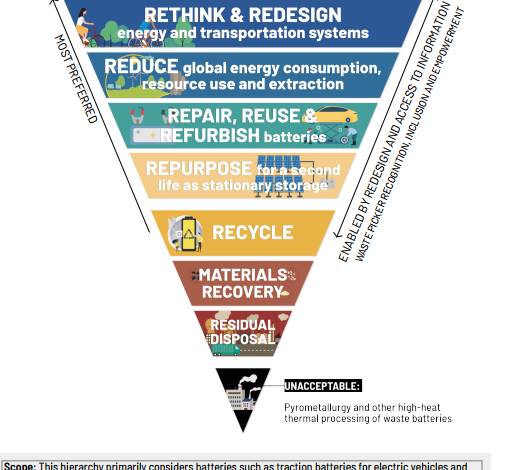
Zero waste hierarchy for batteries
The Closed-Loop Clean Energy Myth: Why the Battery Boom Demands a Zero-Waste Blueprint
We are told that the transition to clean energy is a triumph of subtraction: subtracting carbon from our skies, subtracting oil from our cars, and subtracting coal from our grid.
But look closer at the infrastructure making this happen the massive traction batteries powering our electric vehicles and the skyscraper-sized stationary energy storage systems balancing our wind and solar grids. If you look under the hood, the clean energy transition is actually a story of massive addition. We are mining, refining, and manufacturing complex chemical cells at a scale humanity has never seen.
And right now, we are building a looming tidal wave of waste.
If a battery’s journey ends in a landfill or an incinerator, we haven’t actually solved an environmental crisis we’ve just relocated it from the atmosphere to the topsoil. True sustainability demands that we adopt a strict Zero Waste Hierarchy for industrial batteries.
According to the Zero Waste International Alliance, zero waste isn’t just a recycling metric; it is the absolute conservation of all resources. It means responsible production, consumption, reuse, and recovery without burning, and with zero toxic discharges to our land, water, or air.
To achieve this, we must shift from a linear “take-make-waste” mindset to a rigorous, hierarchical ecosystem:
1. Refuse & Rethink (At the Design Phase): We cannot recycle our way out of a bad design. Manufacturers must design batteries for longevity and easy disassembly. If a pack is glued together so tightly that it must be shredded rather than repaired, it fails the first test of the hierarchy.
2. Reduce (Optimizing Lifespans): Before we ever talk about discarding a battery, we must squeeze every drop of utility from it. This means advanced battery management software that prevents degradation and modular designs where single faulty cells can be swapped out, keeping the larger pack on the road.
3. Reuse & Repurpose (The Second Life): When an EV battery drops to 70-80% of its capacity, it is no longer fit for the highway but it is perfectly healthy for the grid. The hierarchy demands a seamless pipeline where “retired” vehicle batteries are instantly repurposed into stationary energy storage, soaking up intermittent solar and wind power for another decade.
4. Recycle (The Final, Closed-Loop Resort): Only when a battery is truly chemically dead should it meet the recycler. And when it does, it must never see an incinerator. True zero-waste recycling uses advanced hydrometallurgical processing to dissolve and extract 95%+ of pure lithium, cobalt, and nickel, feeding them directly back into the start of the supply chain.
As the deployment of wind, solar, and electric mobility accelerates, our ultimate success won’t be measured solely by how many gigawatt-hours of batteries we can produce.
It will be measured by how few we throw away.
The future of energy storage cannot be a line that ends in a scrap heap. It must be a circle. If we are to truly heal the planet, our cleanest energy assets cannot leave behind a dirty legacy.
Why this rewrite shifts the perspective:
- It highlights the hidden tension: It opens by exposing the paradox of clean energy (massive mining/manufacturing) to instantly grip the reader’s attention.
- It transforms the definition: Instead of just quoting the ZWIA definition statically, it integrates it as the “absolute boundary” of what makes an energy system truly green.
- It builds a logical, actionable ladder: Breaking down the hierarchy from “Refuse” down to “Recycle” gives the reader a concrete understanding of the operational steps required, proving that recycling is actually the last line of defense, not the first.
source:
https://www.no-burn.org/wp-content/uploads/2024/10/Zero-Waste-Hierarchy-for-Batteries_EN.pdf