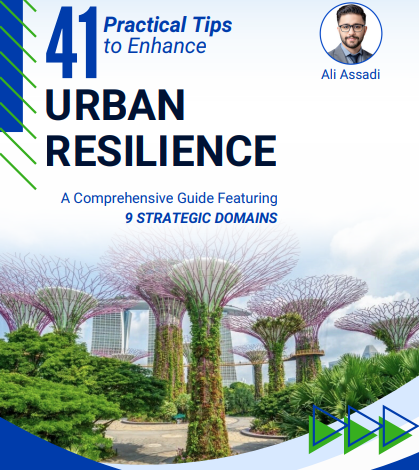
𝟰𝟭 𝗧𝗶𝗽𝘀 𝘁𝗼 e𝗻𝗵𝗮𝗻𝗰𝗲 u𝗿𝗯𝗮𝗻 r𝗲𝘀𝗶𝗹𝗶𝗲𝗻𝗰𝗲
Disasters aren’t waiting for us to get ready. They’re already here. The question is: Will your city withstand the next shock or collapse under pressure?
The Stakes Have Never Been Higher
We are living in an era of cascading risks:
Climate disasters are intensifying. Floods, heatwaves, and wildfires now hit harder and more often.
Urbanization is accelerating. More people, more density, and more pressure on fragile infrastructure.
Nature is losing ground. Deforestation, pollution, and habitat destruction are stripping away natural resilience.
Yet, despite the warnings, too many cities remain unprepared.
Take Tehran, for example: Built on active fault lines, the city is one earthquake away from devastation. Entire communities sit in high-risk zones with little protection.
Or consider the cities drowning under rising sea levels. Jakarta is sinking. Miami is struggling. Coastal hubs worldwide are running out of time.
So, what’s holding us back?
Governments failing to act fast enough
Weak infrastructure & outdated policies
Limited disaster funding & poor risk education
Communities disengaged & unprepared
The Solution? A 9-Domain Strategy for Urban Resilience
Building a city that can withstand the shocks of the future requires action across multiple fronts.
1. Risk Awareness & Education
- Teach disaster preparedness in schools.
- Run city-wide emergency drills.
- Make risk maps & climate projections publicly accessible.
2. Smart Governance & Coordination
- Appoint a Chief Resilience Officer to lead disaster response.
- Set up cross-agency emergency task forces.
- Use real-time data to monitor risks & improve decision-making.
3. Infrastructure Built to Last
- Upgrade roads, bridges, and drainage for extreme weather.
- Adopt nature-based solutions like floodplains & permeable pavements.
- Ensure ALL new buildings meet disaster-resilient standards.
4. Financial Preparedness & Resilience Bonds
- Invest in risk insurance & emergency response funds.
- Establish public-private funding models for climate adaptation.
- Issue green bonds to finance sustainable urban projects.
5. Climate Adaptation & Nature-Based Solutions
- Restore wetlands & mangroves to reduce flood risks.
- Expand urban forests to cool down heatwave-prone areas.
- Implement sponge city designs to absorb excess rainwater.
6. Community-Led Resilience
- Equip neighborhoods with disaster response training.
- Support local resilience hubs for food, water, and medical aid.
- Build stronger social networks—because connected communities recover faster.
7. Energy & Water Security
- Invest in microgrids & renewable energy backups.
- Expand rainwater harvesting & decentralized water systems.
- Design self-sufficient neighborhoods with off-grid capabilities.
8. Transport & Mobility Redesign
- Develop multi-modal evacuation routes.
- Strengthen public transit to reduce congestion during crises.
- Ensure transport networks can withstand extreme weather events.
9. Future-Proofing Through Innovation
- Deploy AI & predictive analytics for disaster forecasting.
- Use drones & robotics for post-disaster recovery.
- Leverage blockchain for emergency aid distribution.
The Bottom Line: Cities That Delay, Pay the Price.
🛑 Resilience isn’t a luxury it’s survival.
🛑 We either prepare now or face catastrophic losses.