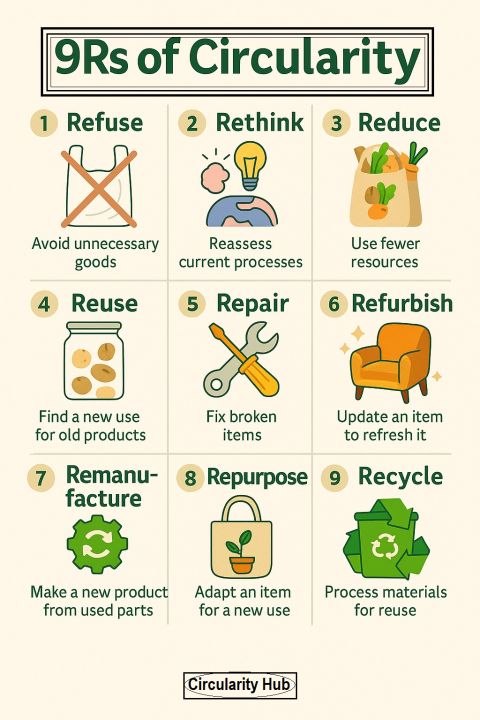
9Rs of Circularity
Most conversations about waste begin with recycling.
But in a truly circular economy, recycling is the last resort, not the first solution.
The framework shown here—the 9Rs of Circularity—offers a smarter roadmap for tackling waste at its source. It challenges organizations, cities, and consumers to move beyond the traditional “take, make, dispose” model and rethink how resources are used throughout their entire lifecycle.
♻️ Refuse what is unnecessary.
💡 Rethink products, systems, and consumption patterns.
📉 Reduce resource use and material intensity.
🔄 Reuse products for longer.
🔧 Repair instead of replacing.
✨ Refurbish to restore value.
🏭 Remanufacture using recovered components.
🎯 Repurpose items for entirely new functions.
♻️ Recycle materials when other options are exhausted.
What makes the 9Rs powerful is their hierarchy.
The higher an action sits on the ladder, the greater its potential to prevent waste, conserve resources, reduce emissions, and create economic value. Refusing unnecessary consumption often has a far greater impact than recycling after the fact.
This shift is driving a new wave of waste innovation:
🔹 Products designed for durability and repairability
🔹 Digital platforms enabling reuse and sharing models
🔹 Advanced remanufacturing systems recovering valuable components
🔹 Industrial symbiosis networks that transform waste streams into resources
🔹 Circular business models that prioritize access over ownership
Waste is no longer just an environmental challenge—it is a design challenge, a business opportunity, and a resource management issue.
The future belongs to systems that eliminate waste before it is created.
Because the most sustainable waste is the waste that never exists in the first place.
Which of the 9Rs do you believe offers the greatest opportunity for transforming our current economy?
https://www.linkedin.com/feed/update/urn:li:share:7467841891540094976