Sustainability transformation horizons
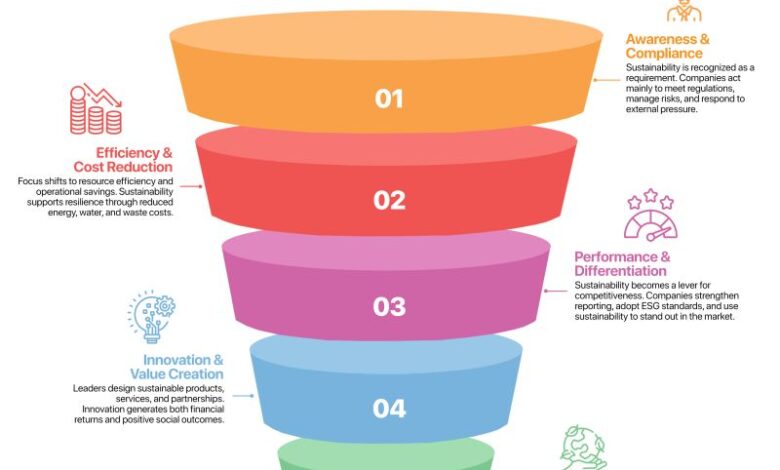
Climbing the Summit: The Five Horizons of Sustainability Transformation
Sustainability is not a fixed goal; it is a dynamic, escalating measure of corporate maturity. The companies that will thrive in the next decade are those that view sustainability not as a compliance burden, but as the central driver of innovation, market differentiation, and long-term value creation.
Most organizations stall at the base of this climb. The strategic imperative is to move decisively from merely managing risk to actively designing a regenerative future.
The Five Horizons of Strategic Evolution
This framework outlines the essential journey every resilient organization must undertake:
| Horizon | Primary Focus | Strategic Outcome | The Mindset Shift |
| 1. Compliance | Regulatory Response | Risk mitigation; avoiding penalties. | We must act because the law requires it. |
| 2. Efficiency | Resource Optimization | Cost reduction; operational resilience. | We can save money by being smarter about resources. |
| 3. Differentiation | Competitive Positioning | Brand value; market preference; reporting excellence. | We can use sustainability to stand out from the competition. |
| 4. Innovation | Value Creation | New products, services, and disruptive business models. | Sustainability is the catalyst for our next wave of growth. |
| 5. Regeneration | Ecosystem Restoration | Net-positive contribution; societal well-being. | Our business model restores the planet and society. |
Regional Reality Check: Where Do Most Companies Stand?
In many major global regions (e.g., Southeast Asia, Latin America, or even many parts of Europe and North America’s mid-market), the majority of companies cluster between Horizon 1 (Compliance) and Horizon 2 (Efficiency).
- The Majority: Horizon 1 & 2 is where most resources are allocated—driven by managing ESG investor requirements, adhering to new local regulations, and finding quick wins through energy and waste efficiency to cut costs.
- The Pioneers: Only a small, elite group has successfully navigated to Horizon 4 (Innovation), treating sustainable outcomes as intellectual property and new revenue streams, while Horizon 5 (Regeneration) remains a rarefied, aspirational destination for true purpose-driven organizations.
The Challenge: Aggressive Horizon-Climbing
The gap between current standing (H1/H2) and competitive necessity (H4/H5) is the “Sustainability Lag.” Relying solely on compliance is no longer enough to manage systemic risks like climate change or social upheaval.
The call to action is clear:
- Move Beyond Cost-Cutting: Treat the savings from efficiency (H2) not as profit, but as re-investable capital for the innovation required in H4.
- Embed Strategy, Not Just Reporting: Use robust standards and reporting (H3) to attract capital and talent, but ensure those reports reflect fundamental business model transformation.
- Make H4 the Default: The future market will reward positive outcomes (H4) over mere risk mitigation (H1). Companies must urgently design products and services that inherently create social and environmental good.
The future belongs not to the compliant, but to the regenerative.
source: