What is global warming?
A World on Fire: Decoding the Crisis of Global Warming
Global warming is not a vague theory or a distant future threat it is the direct and undeniable consequence of the very systems that underpin modern human society. Our planet is overheating, and the urgency of this crisis demands more than just awareness; it requires transformative action.1
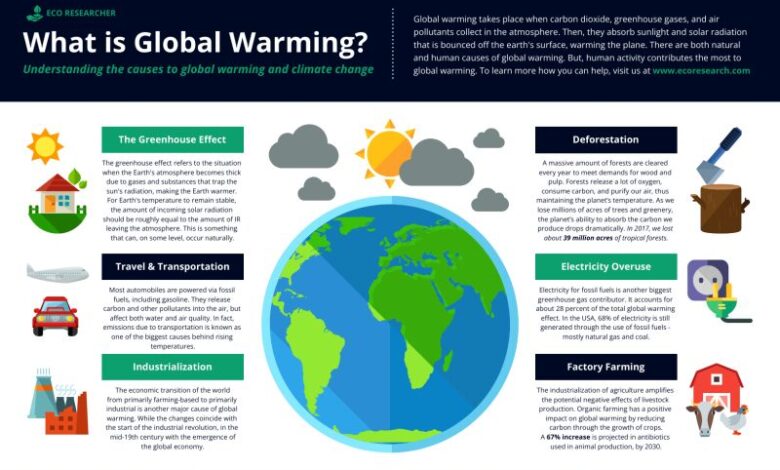
At the core of this monumental problem is the Greenhouse Effect , a vital natural mechanism that has been fundamentally disrupted. While the Earth needs this effect to stay habitable, human activity has intensified it to a dangerous degree.2 When the balance is broken and significantly more heat is trapped than released, the Earth’s average temperature rises we call this Global Warming.
The Engines of Overheating: Five Core Drivers
To solve this crisis, we must confront the massive systems that are actively pushing global temperatures higher:
| Core Driver | Mechanism & Impact | Call to Action |
| Deforestation | Forests are the planet’s natural carbon filters and strongest climate stabilizers (carbon sinks). The loss of millions of acres annually drastically shrinks the Earth’s capacity to absorb rising emissions. | Regenerative Land Use: Prioritize large-scale reforestation and robust protection of existing old-growth forests. |
| Travel & Transportation | This sector is overwhelmingly reliant on fossil fuels (gasoline, diesel). Emissions from cars, trucks, ships, and planes make it one of the largest global sources of greenhouse gases. | Mobility Transformation: Rapidly transition to electric, hydrogen, and other low-carbon transport technologies, coupled with investing in efficient public transit. |
| Industrialization | The rise of large-scale manufacturing since the mid-19th century has supercharged energy consumption and pollution. As global economies continue to expand, this acceleration demands massive inputs of energy, often derived from carbon-intensive sources. | Green Industry: Mandate and invest in industrial processes that utilize carbon capture technology and switch to renewable energy sources for production. |
| Electricity Overuse | Nearly a third of global warming contributions stem from fossil-fuel-based electricity (coal, gas, oil). In many developed and rapidly industrializing nations, this proportion is even higher. | Energy Revolution: Accelerate the deployment of solar, wind, geothermal, and other renewable energy infrastructure to eliminate reliance on fossil fuels for power generation. |
| Factory Farming | The intensive nature of livestock production releases potent climate-warming gases, particularly methane. As global demand for meat and dairy escalates, so does the climate cost of agriculture. | Sustainable Food Systems: Promote plant-based diets, implement sustainable livestock management practices, and invest in alternative protein technologies. |
The Path Forward: System-Level Change
The big picture is undeniable: global warming has multifaceted origins, but every single one points to the urgent necessity of transforming how society produces, powers, moves, and feeds itself.
This is not a time for minor adjustments; it is a time for systemic overhaul. While individual small shifts (like choosing public transport or reducing consumption) are important, they gain maximum leverage when paired with system-level change (like legislation mandating renewable energy targets or banning deforestation).
The future temperature of our planet is being decided by the choices made today. We must choose regeneration and transformation over depletion and inertia.
source: