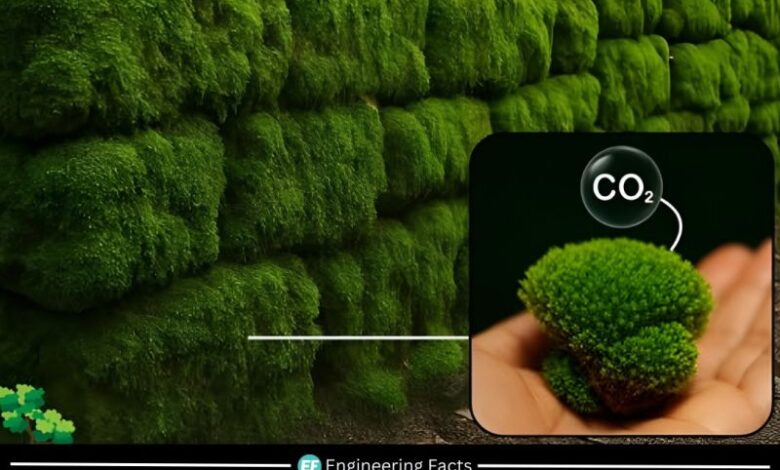
Moss capture 4x more CO2 than trees
The Moss Paradox: Why We Are Erasing the World’s Most Efficient Carbon Sponge
We spend billions planting saplings that struggle to survive in the concrete canyons of our cities. We design elaborate vertical forests and complex irrigation systems for high-maintenance parks.
Meanwhile, in the cracks of our sidewalks, on the shaded faces of our brick walls, and across our rooftops, a quiet revolution is trying to take root. And we respond by scraping it off.
It is time to stop treating Moss as a nuisance and start recognizing it as the ultimate urban climate ally.
The Power of the “Micro-Forest”
Moss doesn’t need soil. It doesn’t need deep root systems. It thrives where trees fail. Yet, pound for pound, this humble bryophyte is a biological powerhouse.
- The 4x Efficiency: Research indicates that certain moss surfaces can capture up to 4x more CO2 per square meter than a mature tree. While a tree stores carbon in its massive trunk over decades, moss works at an incredible density, scrubbing the air in tight urban spaces where no tree could grow.
- The Urban Cooling Effect: Moss acts as a natural evaporative cooler. By retaining massive amounts of moisture and releasing it slowly, a moss-covered wall can significantly lower the temperature of the surrounding micro-climate, fighting the “Urban Heat Island” effect far more effectively than bare concrete.
- Particulate Filtration: Moss leaves have a massive surface area relative to their size, allowing them to trap and “eat” fine dust and particulate matter (PM2.5) that otherwise ends up in our lungs.
A Comparison of Urban Allies
| Feature | Trees | Moss |
| Space Required | Large (Soil & Root depth) | Minimal (Grows on stone/brick) |
| CO2 Capture | High (per individual) | Superior (per square meter) |
| Maintenance | High (Pruning, watering) | Low (Dormancy capable) |
| Growth Speed | Years to reach maturity | Weeks to establish |
| Urban Fit | Streets & Parks | Walls, Roofs, Sidewalks, Tunnels |
Why Are We Scrapping Our Best Defense?
The reason we remove moss is purely aesthetic a relic of a 20th-century mindset that equates “cleanliness” with “sterile gray surfaces.”
By power-washing moss away, we are:
- Releasing captured carbon back into the cycle.
- Increasing surface temperatures of our buildings.
- Wasting a low-maintenance solution that requires zero fertilizer and almost no intervention.
Living Cities: A New Vision
Imagine a city where the gray disappears under a velvet carpet of emerald. A city where the very walls of our subways and the roofs of our bus stops are actively breathing, cooling, and cleaning.
- Moss-Boards: Instead of digital billboards, imagine “CityTrees” integrated moss modules that provide the air-cleaning power of 275 trees in the footprint of a single bench.
- Green Roofs 2.0: Moving away from heavy soil-based gardens to lightweight, resilient moss mats that can be retrofitted onto almost any existing structure.
The future of urban resilience isn’t just about the giants we plant in the ground; it’s about the carpets of green we allow to climb our walls. It’s time to stop fighting the moss and let it fight the climate crisis for us.
source: