Tahukah Anda
10 R’s the circularitiy
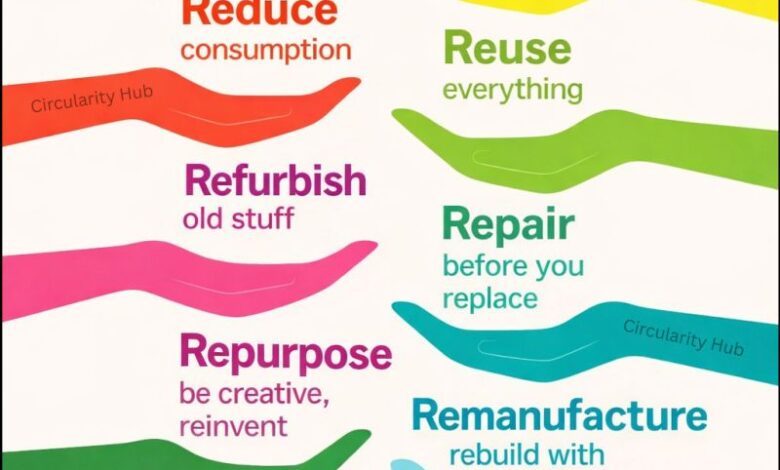
The 10 R’s: A Strategic Playbook for the Circular Revolution
The “Take–Make–Waste” era is reaching its ecological and economic breaking point. Sustainability is no longer a department; it is a fundamental redesign of how we value resources. The 10 R’s of Circularity provide the definitive hierarchy for this transformation, moving from high-level systemic change to end-of-life recovery.
I. The Strategy Phase (Refuse, Rethink, Reduce)
The most powerful circular move is the one that prevents waste before it exists.
- Refuse: Abandoning unsustainable practices or materials (e.g., single-use plastics) entirely.
- Rethink: Challenging the business model. Can we sell a service (lighting) instead of a product (lightbulbs)?
- Reduce: Engineering efficiency to use fewer raw materials and less energy during manufacturing.
II. The Extension Phase (Reuse, Repair, Refurbish, Remanufacture, Repurpose)
Value is preserved by keeping products in their highest utility state for as long as possible.
- Reuse: Promoting second-hand markets and multi-use packaging.
- Repair: Designing for modularity so a single broken part doesn’t kill the whole machine.
- Refurbish: Restoring old products to a functional, “like-new” state.
- Remanufacture: Using components of discarded products in a new product with the same function.
- Repurpose: Finding a new life for a product in a different capacity (e.g., turning EV batteries into stationary grid storage).
III. The Recovery Phase (Recycle, Recover)
The final safety net when a product can no longer function.
- Recycle: Processing materials to be used again, though often with a loss in quality (downcycling).
- Recover: Incineration with energy recovery the last resort before the landfill.
Why Circularity is Your Competitive Advantage
Moving to a circular model isn’t just “green” it’s a hedge against a volatile future.
| Benefit | Impact on Organizations & Communities |
| Resilience | Decoupling growth from finite resource extraction reduces supply chain risk. |
| Efficiency | Lowering input costs by capturing the value of “waste” streams. |
| Job Creation | Repair, remanufacturing, and local loops create high-skill “green-collar” jobs. |
| Brand Loyalty | Aligning with the 75% of consumers who prioritize sustainable brands. |
The Call to Action: From Linear to Looped
The future does not belong to those who extract the most, but to those who circulate the best.
- Audit your waste: Where is your “leakage”? Every piece of trash is a failed design.
- Design for Disassembly: Ask, “How will this be taken apart in five years?”
- Collaborate: Circularity cannot happen in a vacuum. It requires a network of partners to close the loop.
source: