Tahukah Anda
20 basic carbon terms
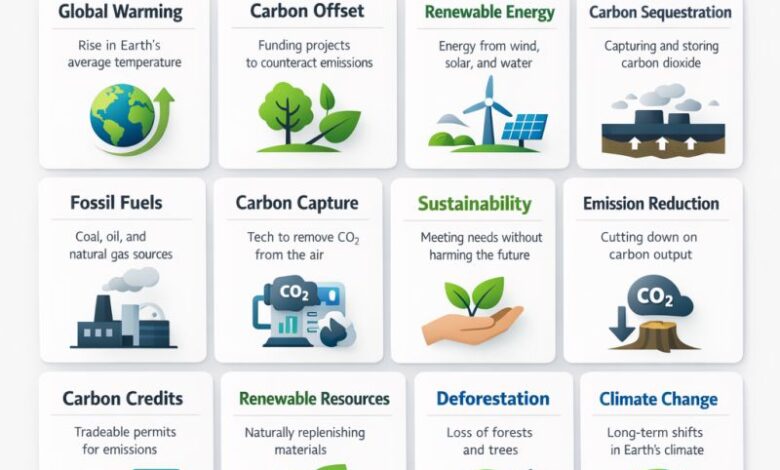
The Foundations: Defining the Problem
Before we can solve the crisis, we must understand how we measure our impact on the atmosphere.
- 1. Greenhouse Gases (GHG): Gases like CO2, methane (CH4), and nitrous oxide (N2O) that trap heat in the atmosphere.
- 2. Carbon Dioxide Equivalent (CO2e): A metric used to compare the emissions from various GHGs based on their global warming potential.
- 3. Carbon Footprint: The total amount of GHGs generated by our actions (individual, corporate, or national).
- 4. Scope 1, 2, & 3 Emissions: A way of categorizing corporate emissions:
- Scope 1: Direct emissions from owned sources (e.g., company vehicles).
- Scope 2: Indirect emissions from purchased energy (e.g., electricity).
- Scope 3: All other indirect emissions in the value chain (e.g., supply chain).
The Balance: Ambition vs. Reality
These terms describe the “end states” or goals that nations and companies strive to achieve.
- 5. Net Zero: A state where any remaining human-caused GHG emissions are balanced by an equivalent amount of carbon removal.
- 6. Carbon Neutral: Similar to Net Zero, but often focused specifically on CO2 and heavily reliant on offsetting.
- 7. Carbon Negative / Climate Positive: Going beyond Net Zero to remove more carbon from the atmosphere than is emitted.
- 8. Decarbonization: The process of reducing or eliminating carbon emissions from an economy or industry.
The Mechanics: Carbon Markets & Finance
How does the world put a price on pollution? These terms define the economic “engine” of climate action.
- 9. Carbon Market: A trading system where carbon credits are sold and bought.
- 10. Carbon Credit: A tradable permit representing the right to emit one tonne of CO2.
- 11. Carbon Offset: A reduction in emissions made in one place to “compensate” for emissions made elsewhere.
- 12. Carbon Tax: A fee imposed by a government on any company that burns carbon-based fuel.
- 13. Cap and Trade: A system that sets a “cap” on emissions and allows companies to trade unused permits.
The Strategy: Tools for Change
These concepts help us evaluate whether a strategy is actually working or if it’s just “smoke and mirrors.”
- 14. Carbon Intensity: The amount of carbon emitted per unit of output (e.g., emissions per GDP or per product made).
- 15. Carbon Sequestration: The process of capturing and storing atmospheric carbon dioxide (either through nature like forests or technology).
- 16. Nature-Based Solutions (NbS): Actions to protect or restore ecosystems that also help capture carbon (e.g., mangrove restoration).
- 17. Carbon Capture, Utilization, and Storage (CCUS): Technology that “catches” carbon at the source (like a factory chimney) and stores it underground.
- 18. Circular Economy: A system aimed at eliminating waste and the continual use of resources, drastically lowering the “embedded carbon” in products.
- 19. Greenwashing: The deceptive practice of making a company appear more environmentally friendly than it actually is.
- 20. ESG (Environmental, Social, and Governance): A framework used by investors to evaluate a company’s sustainability and ethical impact.
Why Carbon Literacy is Your Competitive Advantage
Understanding these 20 terms is more than just an academic exercise—it is a toolkit for accountability. When you master this language, you can:
- Audit Corporate Claims: Distinguish between a company truly achieving Net Zero through innovation versus one simply buying cheap offsets to hide high carbon intensity.
- Evaluate Policy: Understand if a government’s Carbon Tax is high enough to drive real decarbonization.
- Drive Strategy: For professionals, it allows for the integration of ESG metrics into core business decisions.
Sustainability isn’t just about the technology we build; it’s about the clarity with which we communicate the path forward.