How climate risk affect business operations
The Operational Frontline: From Resilience to Survival
Climate events are no longer “one-off” disruptions. They are persistent stressors that redefine the cost of doing business.
1. Operations & Workforce Bio-Capacity
Extreme heat doesn’t just “feel uncomfortable”; it hits a biological ceiling for labor. As wet-bulb temperatures rise, workforce productivity becomes a variable rather than a constant. Forward-thinking firms are moving beyond “safety protocols” toward resilience engineering—redesigning facilities and shifts to account for a harsher atmosphere.
2. The Supply Chain “Bullwhip” Effect
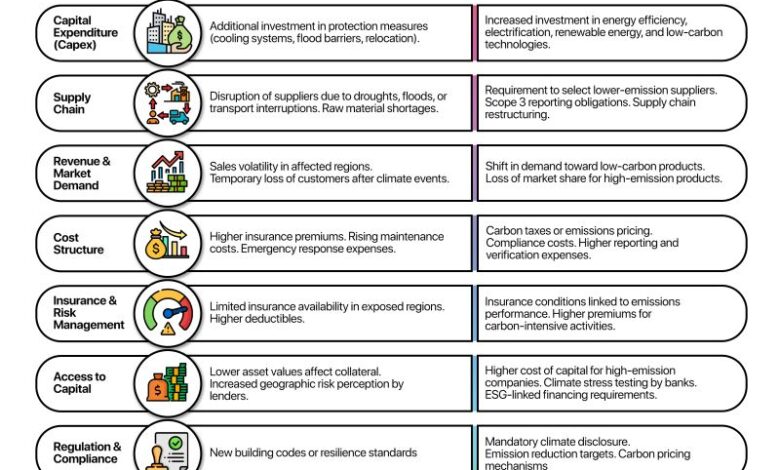
Droughts in one hemisphere now lead to raw material shortages in another. In a globalized value chain, a climate event 5,000 miles away is a domestic delivery failure. Resilience now means de-risking through diversification and moving away from “just-in-time” to “just-in-case” inventory models.
Financial Fundamentals: The New Valuation Metrics
If your assets are in high-risk zones, their “book value” is a fiction.
3. Asset Stranding & CapEx Realignment
Infrastructure with a 30-year lifespan must now be stress-tested for 2055 weather patterns. Companies are being forced into massive Capital Expenditure (CapEx) shifts:
- Installing industrial-scale cooling systems.
- Building flood defenses for coastal data centers.
- Relocating vulnerable manufacturing hubs.
4. The Cost of Capital & Insurance
The “Climate Premium” is real. Banks and institutional investors are now using TCFD and ISSB frameworks to price risk. If your transition strategy is weak, your interest rates go up. If your location is indefensible, your insurance premiums or the lack of insurability could render your business model obsolete.
Strategy & M&A: The Decarbonization Alpha
In the current market, a company’s climate exposure is as critical as its EBITDA during due diligence.
- Revenue Shift: Consumer demand is moving toward low-carbon products with a velocity that many legacy firms are failing to track.
- M&A Due Diligence: Acquisitions are now being valued based on their carbon liability. An attractive target today could be a “toxic asset” tomorrow if it is tied to high-emission energy or vulnerable geography.
We are moving from a world of “Relative Risk” to “Absolute Constraint.” Carbon pricing and regulation are not just compliance hurdles; they are the new boundaries of the playing field.
Integration is the Only Option
Climate risk has migrated from the sustainability office to the Boardroom and the CFO’s desk. It is the thread that runs through every function from HR to Strategy.
The question for leadership is no longer “How do we report this?” but “How do we rebuild our business to thrive within these new planetary boundaries?”
The climate is changing the math. It’s time to update the spreadsheet.