Building homes from waste
The Alchemy of Ash: How We Are Building Tomorrow From What We Throw Away
What if the foundation of our future cities isn’t buried deep in the Earth’s crust, but sitting right now in our industrial waste dumps?
For decades, the math of human progress has been simple and destructive: extract, consume, discard. We dig up limestone to fire up cement kilns, releasing torrents of carbon into the atmosphere, while on the other side of town, factories pile mountains of industrial byproduct into landfills.
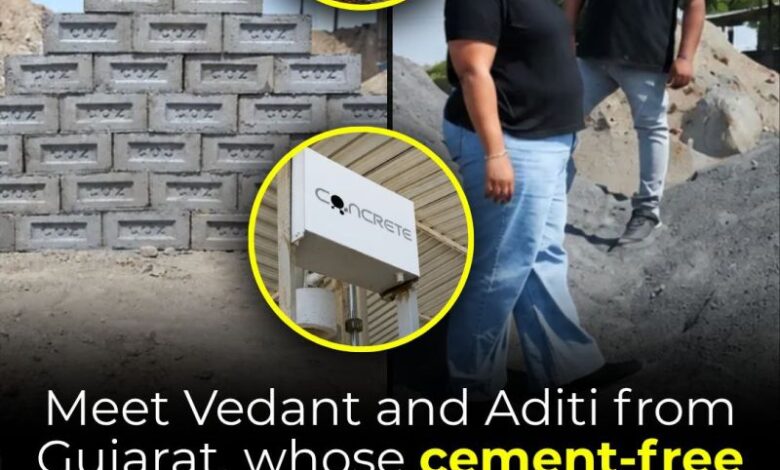
But in Gujarat, India, a startup is proving that we can break this cycle. They aren’t just making bricks; they are practicing a form of modern environmental alchemy turning hazardous industrial waste into cement-free, high-performance eco-bricks.
To date, this single shift in perspective has already laid the walls for over 450 sustainable homes.
The Hidden Toll of the Concrete Jungle
To understand why this matters, we have to look at the invisible cost of standard gray concrete. Traditional cement production is a climate heavy; it is responsible for roughly 8% of global CO2 emissions. If the cement industry were a country, it would be the third-largest emitter in the world, trailing only China and the US.
By replacing carbon-heavy cement with chemically activated industrial waste, this technology achieves three critical victories at once:
- Weaponizes Waste: It intercepts industrial byproducts before they can leach into local soil and water tables.
- Starves the Kilns: It bypasses the high-heat, high-emission baking process required by traditional brick and cement production.
- Builds Equity: It provides a durable, structurally sound, and highly affordable building block for communities that need housing most.
This is the circular economy in its purest, most tangible form. It moves us away from the outdated goal of simply “reducing harm” and pushes us toward a system that actively repairs the damage already done.
Low-Tech Brilliance in a High-Tech Obsession
There is a vital lesson hidden in the dust of these eco-bricks. In our race to solve the climate crisis, we often obsess over speculative, billion-dollar technologies futuristic carbon-capture facilities or complex synthetic materials.
But true innovation is rarely about making things more complicated. It’s about looking at a pile of discarded material and having the imagination to see a neighborhood.
[Traditional Linear Model]  --> Extract Raw Materials --> High-Emission Manufacturing --> Landfill Waste

[Gujarat Circular Model]    --> Intercept Factory Waste --> Low-Emission Activation --> 450+ Eco-Homes
As urban populations swell and climate pressures intensify, the construction industry can no longer afford to build the old way. The structures of tomorrow must do more than just provide shelter; they must act as active carbon sinks and waste managers.
The cities of the future will not be defined by how much raw nature we can conquer and concrete over. They will be defined by our willingness to rebuild the world using the very pieces we once threw away.
source:
https://www.linkedin.com/feed/update/urn:li:activity:7478343360655646720