Bridging the Chasm bringing Indonesia’s green economy down to Earth
When we hear the term “Green Economy,” it can sound like something that belongs in international summits, policy documents, or glossy corporate sustainability reports. We imagine charts showing declining carbon emissions, massive renewable-energy projects, electric vehicles, and futuristic cities powered by clean energy.
But beneath all the terminology, the idea is remarkably simple:
How can Indonesia grow economically without destroying the natural systems that sustain us—and, more importantly, how can the people who protect those systems share in the economic value they create?
For Indonesia, this is not merely a question of environmental ambition. It is a question of economic resilience, social justice, and long-term survival.
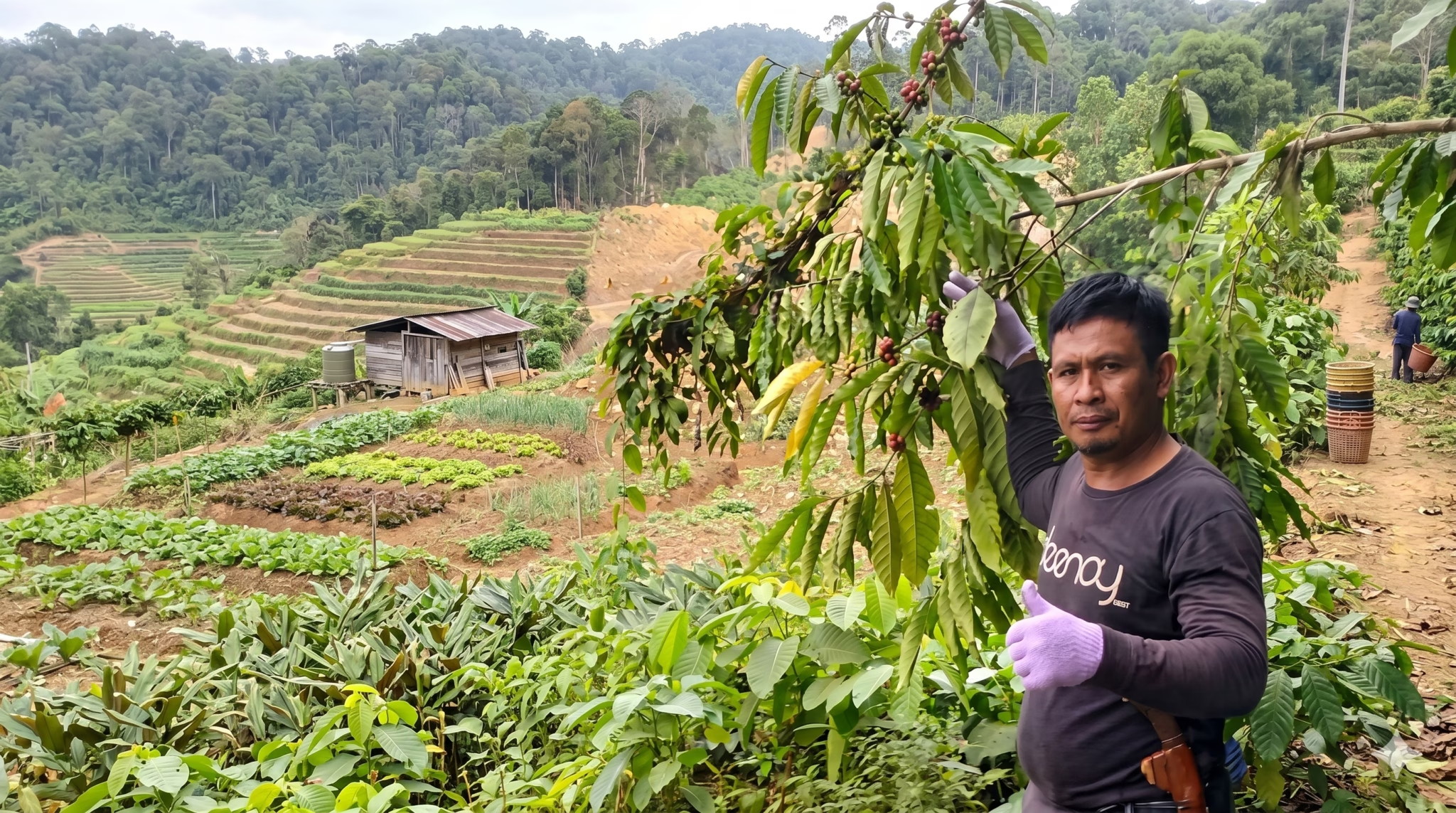
Indonesia possesses extraordinary natural capital: tropical forests, mangroves, peatlands, coral reefs, rivers, agricultural landscapes, and marine ecosystems. These ecosystems provide services that underpin the economy—from clean water and food to flood protection, carbon sequestration, tourism, and livelihoods.
Yet there remains a significant gap between Indonesia’s national green-economy aspirations and what communities, businesses, and local institutions experience on the ground.
This gap became one of the important reflections emerging from the Green Economy Forum hosted by IKA Unpad on June 17, 2026.
To understand why Indonesia’s green transition can feel slower and more fragmented than its ambitions suggest, we need to look at three interconnected layers: the communities protecting nature, the institutions translating policy into action, and the markets that determine whether sustainable products can actually compete.
1. Upstream: The People Protecting Nature Are Often the Ones Left Behind
The green economy does not begin in a ministry office or at an international conference.
It begins on the ground.
It begins along rivers, inside forests, around agricultural landscapes, on coastlines, and in communities whose livelihoods depend directly on healthy ecosystems.
Consider the Ciliwung River in Java. Community-based organizations such as Komunitas Peduli Ciliwung (KPC) have worked to clean polluted waterways, restore riverbanks, plant trees, and raise public awareness.
Their contribution may appear small when measured against national environmental targets. But collectively, this type of work helps maintain ecosystem health and contributes to reducing environmental risks that eventually affect downstream communities, including Jakarta.
The paradox is that the environmental value they create is much larger than the financial resources available to them.
Many grassroots environmental communities still depend on sporadic donations, small grants, volunteerism, and corporate social responsibility programs. Their ability to plan long-term conservation activities can therefore be limited by short-term funding.
Now move from the river to the forests of Mount Halimun Salak, where the Indigenous Kasepuhan Ciptagelar community has maintained traditional environmental practices for generations.
One example is leuweung tutupan, a customary approach to protecting designated forest areas. Such practices demonstrate that conservation is not necessarily a new concept imported through modern environmental policy. Indigenous communities have developed their own sophisticated systems for maintaining ecological balance, managing resources, and protecting forests.
This creates an uncomfortable question:
Why are the people who have been protecting ecosystems for generations often not the primary beneficiaries of the economic value generated by those ecosystems?
The public benefits from clean water.
Cities benefit from flood regulation.
Industries benefit from natural resources.
The global community benefits from carbon sequestration and biodiversity.
Yet the communities carrying the direct costs of conservation can remain economically vulnerable.
This is where the green economy must evolve beyond the idea of “protecting nature” toward the idea of “creating economic value for those who protect nature.”
2. The Middle: When Green Ambition Meets Fragmented Institutions
If the upstream communities are struggling to capture value from conservation, the next question is: what happens in the middle?
This is where policies are designed, budgets are allocated, regulations are created, permits are issued, and national strategies are translated into implementation.
And this is where another major challenge emerges: institutional fragmentation.
A successful green transition requires different parts of government to move in the same direction.
Bappenas may develop ambitious low-carbon development strategies. The Ministry of Finance must determine how public finances and incentives can support those ambitions. Environmental authorities must protect ecosystems. Energy authorities must accelerate the transition toward cleaner energy. Sectoral ministries must align their policies with environmental and climate objectives.
But when these institutions operate according to different priorities, timelines, regulations, or performance indicators, a green policy can become trapped between institutions.
The challenge is not necessarily a lack of good policies.
Sometimes, the problem is that good policies do not connect with one another.
Rooftop solar is a useful illustration.
There is growing interest among households and businesses in installing PLTS Atap. Solar energy supports Indonesia’s broader ambitions to reduce emissions and diversify its energy system.
Yet implementation can become complicated when regulations, technical requirements, grid considerations, quotas, and institutional responsibilities create uncertainty for potential users.
The result is a classic policy paradox:
The public may be ready to transition, technology may already exist, and the national strategy may support it—but the institutional system can still slow everything down.
This is why Indonesia’s green transition needs more than individual ministry programs. It requires policy synchronization.
One approach that can help is the Penta-Helix model, which brings together five key actors:
- Government – creates policy, regulation, and incentives.
- Academia – provides research, knowledge, and innovation.
- Business – provides investment, technology, and market access.
- Civil society/community – represents citizens, local knowledge, and social accountability.
- Media – strengthens public awareness, transparency, and communication.
The green economy is too complex to be managed by government alone.
Climate change, biodiversity loss, waste, energy transition, sustainable agriculture, green finance, and circular economy development cut across institutional boundaries.
If the problem crosses boundaries, the solution must do the same.
3. Downstream: Where Sustainability Meets the Reality of the Market
Even when communities successfully produce sustainable products, another problem appears when those products try to reach larger markets.
Imagine a cooperative producing high-quality organic heritage rice, sustainably harvested forest honey, or naturally dyed textiles.
The product may be environmentally responsible.
The community may be protecting biodiversity.
The production process may generate local employment.
But getting the product from a village to a supermarket—or even to an international buyer—can be surprisingly difficult.
The barriers are often practical:
- expensive sustainability certifications;
- limited access to environmentally friendly packaging;
- high logistics and transportation costs;
- limited cold-chain or storage infrastructure;
- complicated inter-island transportation;
- limited access to affordable green financing; and
- weak connections between small producers and major buyers.
For an archipelagic country like Indonesia, geography itself can become an economic challenge.
Transporting products from eastern Indonesia to Jakarta can involve multiple logistics stages, ports, shipping routes, and additional costs. Delays, fuel surcharges, and fragmented distribution networks can make sustainable local products significantly more expensive.
Meanwhile, imported products from neighboring countries can sometimes arrive at Indonesian markets with stronger supply-chain integration, standardized certification, and better-established market channels.
The result is ironic.
Indonesia may have the natural resources, traditional knowledge, local producers, and sustainability potential—but still struggle to compete in the market for sustainable products.
The green economy therefore cannot stop at production.
It must also answer a fundamental market question:
Can a sustainable product reach consumers at a competitive price?
4. Thailand’s BCG Experience: A Lesson in Connecting the System
The experience of Thailand offers an interesting regional comparison.
Through its Bio-Circular-Green (BCG) Economy framework, Thailand has attempted to connect environmental sustainability with industrial development, investment, innovation, and market competitiveness.
The important lesson is not that Indonesia should simply copy Thailand.
Rather, it is that green transformation requires an ecosystem.
Government incentives, investment policy, certification, research, infrastructure, logistics, financing, and market access need to reinforce one another.
For Indonesian producers, a similar ecosystem could help turn sustainability from an additional cost into a genuine competitive advantage.
Instead of asking small producers to independently finance certification, sustainable packaging, logistics, technology, and market development, the system should help reduce these barriers.
Because ultimately, a green economy cannot succeed if being green is consistently more expensive and more difficult than being unsustainable.
5. From Green Policy to Green Economic Opportunity
This is perhaps the most important shift in thinking.
Indonesia should not see the green economy merely as a collection of environmental restrictions.
It should be seen as an opportunity to build new industries, new livelihoods, new markets, and new sources of national competitiveness.
The transition can create opportunities across sectors:
Nature-based solutions can create income for local communities.
Renewable energy can create new businesses and technical jobs.
Circular economy models can transform waste into valuable materials.
Sustainable agriculture can improve farmer resilience and market access.
Blue economy initiatives can create value while protecting marine ecosystems.
Green manufacturing can strengthen Indonesia’s position in global supply chains.
Green finance can redirect capital toward sustainable economic activities.
The challenge is making sure these opportunities do not remain concentrated among large corporations or urban centers.
The transition must reach the villages, cooperatives, informal workers, farmers, Indigenous communities, entrepreneurs, and local governments that form the foundation of Indonesia’s economy.
6. Three Bridges Indonesia Needs to Build
If the green economy is a journey, Indonesia currently has many roads but not enough bridges.
Bridge 1 Reward the Frontline Guardians
Communities that conserve ecosystems should not be expected to rely indefinitely on volunteerism.
Indonesia needs stronger mechanisms to recognize and compensate ecological stewardship.
One example is Ecological Fiscal Transfer (EFT)—a fiscal mechanism that incorporates ecological performance or environmental criteria into intergovernmental transfers.
The principle is straightforward:
If a region carries the cost of protecting an ecosystem that provides benefits far beyond its borders, that contribution should have economic value.
A community protecting forests, watersheds, mangroves, or biodiversity should not be treated as economically “unproductive” simply because its greatest contribution cannot be captured through conventional GDP measurements.
Nature has value.
And protecting nature has value.
The economic system must learn how to recognize both.
Bridge 2 Break Down the Institutional Silos
Indonesia needs stronger mechanisms for coordinating climate, environmental, energy, industrial, fiscal, and development policies.
A green-economy strategy should not be a collection of disconnected sectoral programs.
Targets must be aligned.
Budgets must support those targets.
Regulations must reinforce one another.
Performance indicators must encourage collaboration rather than institutional competition.
And importantly, implementation must involve communities, academia, businesses, and civil society.
The Penta-Helix approach can provide an important platform for making this coordination more practical and inclusive.
Bridge 3 Build the Green Highway to the Market
Sustainable businesses need more than encouragement.
They need infrastructure.
They need affordable financing.
They need technology.
They need certification support.
They need reliable logistics.
They need market connections.
And they need consumers who are willing and able to buy sustainable products.
Banks and financial institutions can play an important role through accessible green financing. Government can reduce certification and logistics barriers. Large corporations can create sustainable procurement programs. E-commerce platforms can connect small producers with wider markets.
The objective should be simple:
Make it easier for Indonesian businesses to produce sustainably and easier for consumers to choose sustainable Indonesian products.
7. The Green Economy Must Be Measured by Who Benefits
Perhaps the biggest danger is that Indonesia succeeds in building a “green economy” on paper while leaving the people closest to nature behind.
We can build renewable-energy capacity.
We can publish sustainability reports.
We can establish carbon markets.
We can launch green-finance instruments.
We can announce ambitious climate targets.
But these achievements should ultimately lead to a more fundamental question:
Who benefits from the transition?
Does the farmer receive better income?
Does the Indigenous community gain stronger economic security?
Does the informal waste worker receive better protection?
Does the local entrepreneur gain access to new markets?
Does the village receive compensation for protecting its ecosystem?
Does the young generation gain access to decent green jobs?
If the answer is no, then we may be building a greener economy but not necessarily a fairer one.
8. From “Green” as a Policy to Green as a Social Contract
Indonesia’s green transition should ultimately become more than an environmental program.
It should become a social contract between nature, government, business, and society.
Those who consume environmental resources should contribute to their protection.
Those who protect ecosystems should receive fair recognition and economic benefits.
Those who innovate should receive access to capital and markets.
And those who are most vulnerable to environmental change should not be asked to carry the greatest burden of the transition.
This is where the idea of a green economy becomes deeply human.
It is not ultimately about carbon numbers, solar panels, electric vehicles, or sustainability reports.
It is about designing an economy in which prosperity does not require the destruction of the systems that make prosperity possible.
Bringing the Green Economy Down to Earth
Indonesia does not lack green-economy ambition.
What we lack is stronger connectivity between the people protecting nature, the institutions creating policy, and the markets creating economic value.
The upstream communities need resources and recognition.
The middle needs coordination and policy coherence.
The downstream needs financing, infrastructure, logistics, and market access.
Only when these three layers begin working as one system can Indonesia move from green promises to green prosperity.
The real test of Indonesia’s green economy will not be how impressive our policies look at international forums.
It will be whether a community protecting a river can sustain itself.
Whether an Indigenous community protecting a forest can prosper without destroying it.
Whether a small producer in eastern Indonesia can sell a sustainable product competitively in Jakarta.
Whether a young Indonesian can build a decent career in the green economy.
And whether economic growth can finally be measured not only by what we extract from nature—but also by what we are able to preserve for the generations that come after us.
The green economy must come down to earth.
Not only into government policy.
Not only into corporate strategy.
But into villages, communities, businesses, markets—and ultimately, into the everyday lives of Indonesians.
source:
https://seadophile.substack.com/p/bridging-the-chasm-bringing-indonesias