GRI, SASB, ISSB, TCFD, why are there so many ESG frameworks?
Decoding the ESG Framework Landscape: From Impact to Enterprise Value
Navigating corporate sustainability disclosures often feels like deciphering an alphabet soup of acronyms. However, the proliferation of frameworks is not a sign of redundancy it reflects the fundamental difference in who the information is for and what purpose it serves.
Understanding the ESG disclosure ecosystem requires examining the distinct logic, primary audience, and core focus behind each major standard.
The Core Continuum: Double Materiality
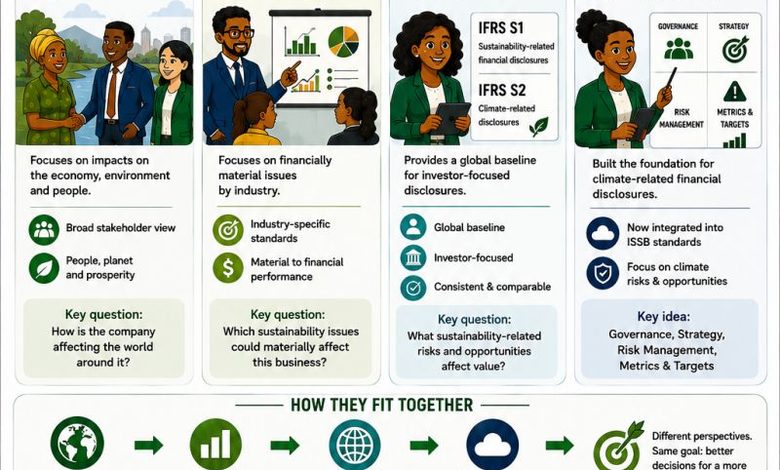
At the heart of the framework divergence lies the concept of materiality. Reporting standards generally fall along a spectrum between two distinct perspectives:
- Impact Materiality (Inside-Out): How a company’s operations affect the surrounding ecosystem, local communities, and society at large.
- Financial Materiality (Outside-In): How environmental, social, and governance risks directly impact the company’s enterprise value, cash flows, and financial performance.
                 THE MATERIALITY SPECTRUM

 [ Impact Materiality ] <====================> [ Financial Materiality ]
 (Inside-Out Impact)                             (Outside-In Risk)

 Focus: Society, People, Planet                 Focus: Enterprise Value, Capital
 Primary Standard: GRI                           Primary Standards: SASB, ISSB, TCFD
 Target: Broad Stakeholders                      Target: Investors & Lenders
Architectural Comparison of Major Frameworks
| Framework / Standard | Primary Lens | Target Audience | Key Structural Feature | Current Status & Evolution |
| GRI (Global Reporting Initiative) | Impact Materiality | Multi-stakeholder (NGOs, communities, employees, public) | Modular standards applicable to any organization, regardless of size or sector. | Widely adopted global default for general sustainability and impact reporting. |
| SASB (Sustainability Accounting Standards Board) | Financial Materiality | Capital providers (Investors, lenders, analysts) | 77 industry-specific standards identifying financially material ESG factors. | Consolidated under the Value Reporting Foundation, now absorbed into the IFRS Foundation/ISSB. |
| TCFD (Task Force on Climate-related Financial Disclosures) | Climate Risk & Governance | Capital providers & regulators | 4 Pillar Framework: Governance, Strategy, Risk Management, Metrics & Targets. | Disbanded in 2023 after its framework was fully integrated into the ISSB (IFRS S2). |
| ISSB (International Sustainability Standards Board) | Global Financial Baseline | Capital providers | IFRS S1 (General Sustainability) & IFRS S2 (Climate Specific Disclosures). | Serving as the new global baseline for investor-grade ESG reporting worldwide. |
Convergence and the Future Baseline
The market is shifting rapidly from fragmented voluntary disclosures toward standardized financial reporting.
Rather than operating in silos, the landscape is consolidating around a complementary architecture:
- The Global Baseline: The ISSB (IFRS S1 & S2) builds directly on TCFD’s four-pillar structure and incorporates SASB’s industry-specific metrics to create a rigorous, investor-focused financial disclosure standard.
- The Interoperability Standard: Recognizing that financial risk and societal impact are deeply interconnected, the ISSB and GRI have established an interoperability alliance. This allows corporations to report using GRI for broad stakeholder accountability while utilizing ISSB standards for capital market disclosures.
Ultimately, effective corporate reporting is moving away from simply publishing a static sustainability report. The focus has shifted toward producing decision-useful, verifiable data tailored precisely to the analytical needs of each stakeholder group.
source:
https://lnkd.in/p/eYYqHSdU