There Is No Such Thing as a “Natural Disaster”: Why Disasters Are Shaped by the Way We Build Society
Earthquakes, floods, cyclones, volcanic eruptions, and extreme weather events are often described as “natural disasters.” But that phrase can be misleading. The hazard itself may be natural, yet the disaster that follows is shaped by human exposure, vulnerability, planning, inequality, infrastructure, environmental conditions, and the capacity of communities to respond.
A powerful way to understand disaster risk is to separate the hazard from the disaster.
An earthquake is a hazard. A flood is a hazard. A cyclone is a hazard.
Whether that hazard becomes a disaster depends largely on what it encounters.
If a strong earthquake strikes an uninhabited area, there may be little human loss. If the same earthquake strikes a densely populated city with poorly constructed buildings, limited emergency access, fragile infrastructure, and high levels of poverty, the consequences can be devastating.
The physical event may be the same. The outcome is not.
Disasters Are Produced by Risk
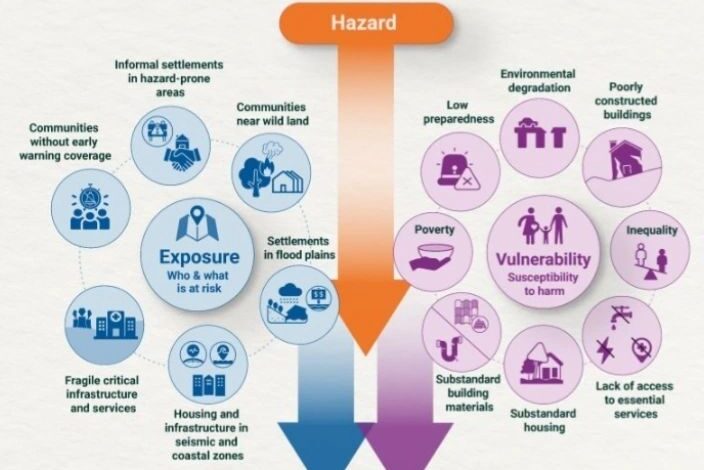
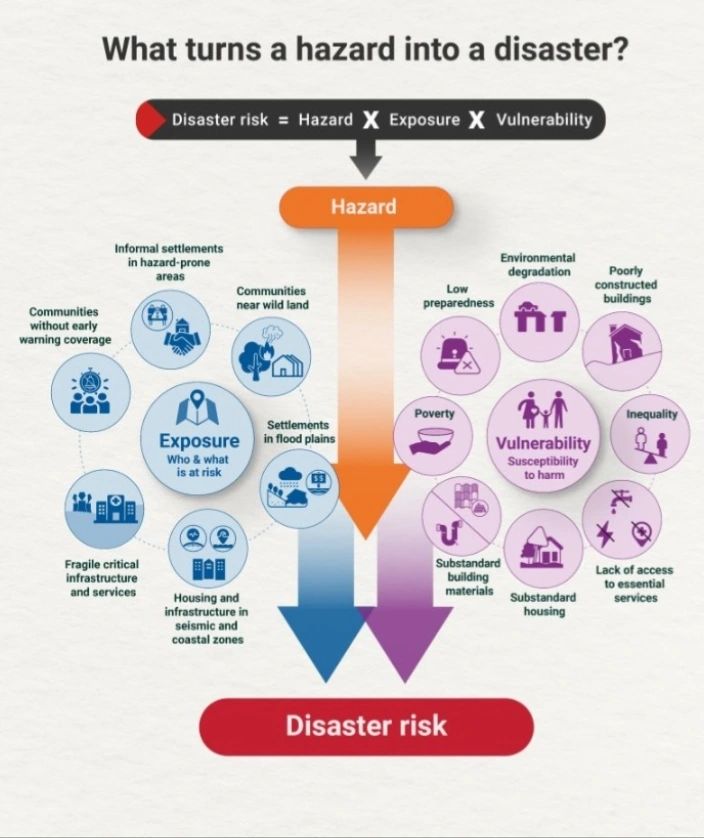
Disaster risk can be understood through three fundamental components: hazard, exposure, and vulnerability.
Hazard refers to the potential severity and frequency of an event. A city located near an active fault faces earthquake hazard. A coastal settlement exposed to tropical storms faces cyclone and storm-surge hazard. A community living along a floodplain faces flood hazard.
Exposure describes the people, homes, businesses, infrastructure, ecosystems, and economic assets located in areas where hazards may occur.
Vulnerability describes how susceptible those people and assets are to damage.
When high hazard, high exposure, and high vulnerability come together, disaster risk becomes much greater.
This distinction changes the way we think about disasters.
Instead of asking only, “Why did nature cause so much destruction?”, we can ask a more useful question:
“Why were so many people and systems vulnerable when the hazard occurred?”
Exposure Is Often the Result of Development Choices
People do not always choose freely where they live.
Rapid urbanisation, housing shortages, inequality, poverty, land prices, employment patterns, and weak spatial planning can push communities into high-risk areas.
Informal settlements may develop beside rivers because safer land is unaffordable.
Homes may be constructed on unstable slopes because cities have not provided adequate housing.
Coastal areas may become heavily developed despite growing flood and storm-surge risks.
Critical infrastructure may be built without sufficient consideration of future climate conditions.
In these cases, exposure is not simply an accident.
It is partly produced by the way cities and economies develop.
That is why disaster risk reduction is closely connected to housing policy, urban planning, infrastructure investment, environmental protection, and social policy.
Vulnerability Determines Who Suffers Most
Two families can experience the same flood and have completely different outcomes.
One may live in a strong building, have insurance, savings, transportation, access to information, and the ability to temporarily relocate.
Another may live in fragile housing, depend on daily income, have no financial reserves, and lack access to emergency services.
The hazard is the same.
The vulnerability is different.
This is why disasters often affect poorer communities more severely.
Poverty can limit access to safer housing.
Inequality can reduce access to infrastructure and emergency services.
Weak healthcare systems can increase mortality after disasters.
Lack of social protection can make recovery much harder.
The damage caused by a disaster is therefore strongly influenced by social and economic conditions that existed long before the hazard occurred.
Disaster Losses Can Reveal Development Failures
Seen from this perspective, disasters can act as indicators of weaknesses in development.
Collapsed buildings may reveal weak construction standards or poor enforcement.
Repeated urban flooding may reveal inadequate drainage, excessive land sealing, poor watershed management, or development in flood-prone areas.
Severe impacts from heatwaves may reveal insufficient urban trees, poor housing quality, lack of cooling access, or inadequate protection for vulnerable populations.
Large losses after storms may reveal fragile infrastructure or destruction of natural coastal protection such as mangroves and wetlands.
This is why disaster risk can be understood as a measure of how sustainable development really is.
A city may appear economically successful, but if its infrastructure, housing, ecosystems, and social systems cannot withstand predictable hazards, that development remains fragile.
Poverty and Inequality Are Major Risk Drivers
Disaster risk is deeply connected to inequality.
Low-income households often live in locations where land is cheaper but hazards are greater.
They may have less access to insurance, savings, transportation, healthcare, and political influence.
After a disaster, wealthier households may rebuild relatively quickly.
Poorer households can lose years of accumulated assets in a single event.
This creates a dangerous cycle.
Poverty increases disaster vulnerability, and disasters can deepen poverty.
Breaking that cycle requires disaster risk reduction to become part of broader social and economic policy.
Poorly Planned Urbanisation Creates Risk
Cities are growing rapidly around the world.
When urban growth happens faster than infrastructure and planning can keep up, disaster risk can increase dramatically.
More buildings are constructed.
More roads are paved.
Natural drainage areas disappear.
Wetlands are filled.
Rivers are narrowed.
Slopes are developed.
Population density increases.
If planning does not account for hazards, exposure grows faster than resilience.
Urban development therefore has the power either to create future disasters or prevent them.
A well-planned city can reduce risk through building codes, flood management, green infrastructure, emergency access, resilient utilities, and risk-informed land-use planning.
Environmental Degradation Can Increase Hazard Impacts
Healthy ecosystems often provide natural protection.
Mangroves can reduce wave energy.
Wetlands can store floodwater.
Forests can stabilise slopes and regulate water flows.
Vegetation can reduce erosion.
Urban trees can reduce heat exposure.
When ecosystems are degraded, communities can lose these protective functions.
Deforestation can increase erosion and runoff.
Wetland destruction can worsen flooding.
Mangrove loss can increase coastal exposure.
Land degradation can amplify drought and water scarcity.
Environmental conservation is therefore not separate from disaster risk reduction.
It is part of disaster prevention.
Climate Change Is Changing the Risk Landscape
Climate change adds another layer of complexity.
It does not create every hazard, but it can alter the frequency, intensity, duration, or geographic distribution of some climate-related hazards.
Extreme rainfall can become more intense.
Heatwaves can become more frequent and severe.
Sea-level rise can increase coastal flooding.
Drought conditions can become more persistent in some regions.
Wildfire risk can increase under hotter and drier conditions.
This means historical experience may no longer be enough to guide future planning.
Infrastructure designed for yesterday’s climate may not be adequate for tomorrow’s conditions.
Climate adaptation and disaster risk reduction therefore need to become increasingly integrated.
Resilience Is the Fourth Dimension
Hazard, exposure, and vulnerability explain much of disaster risk, but another concept is equally important: resilience.
Resilience is the capacity of communities, institutions, infrastructure, ecosystems, and economies to absorb shocks, recover, adapt, and continue functioning.
A resilient community does not necessarily avoid every disaster impact.
Instead, it limits losses and recovers more effectively.
Resilience can come from many sources.
Strong building codes reduce collapse risk.
Early-warning systems give people time to evacuate.
Reliable emergency services save lives.
Social protection helps families recover.
Diversified livelihoods reduce economic vulnerability.
Healthy ecosystems provide natural protection.
Strong community networks help people support one another.
Resilience is therefore both physical and social.
Early Warning Can Save Lives
One of the clearest examples of resilience is early-warning capacity.
Cyclones cannot be prevented.
But deaths from cyclones can be dramatically reduced when communities receive accurate warnings, evacuation routes are available, shelters are accessible, and people trust the information they receive.
The same principle applies to floods, heatwaves, volcanic activity, and many other hazards.
The hazard may remain.
The disaster impact can change.
That difference demonstrates why disaster mortality is not predetermined by nature.
Building Back Better Matters
Recovery after disasters also creates an important decision point.
Communities can rebuild the same vulnerabilities that existed before, or they can reduce future risk.
Reconstructing stronger buildings can reduce earthquake losses.
Moving critical infrastructure away from high-risk areas can reduce future exposure.
Restoring mangroves can strengthen coastal protection.
Improving drainage can reduce repeated flooding.
Updating building standards can prevent future structural failures.
This is the idea behind building back better.
Recovery should not merely restore what existed before.
It should reduce the weaknesses that allowed the disaster to become so destructive.
Small, Repeated Disasters Matter Too
Public attention often focuses on major catastrophes.
But smaller disasters can create enormous cumulative losses.
Repeated local floods.
Small landslides.
Seasonal drought.
Coastal erosion.
Heat stress.
Localised fires.
These events may not dominate international headlines, but they can steadily erode livelihoods, infrastructure, savings, and public finances.
For poorer communities, repeated small losses can be particularly damaging.
This is sometimes described as extensive risk.
Reducing this form of risk is essential because development gains can be gradually lost through repeated shocks.
The Language We Use Matters
Calling something a “natural disaster” can unintentionally make destruction sound inevitable.
But disasters are rarely inevitable.
Hazards may be unavoidable.
Earthquakes will continue to occur.
Storms will continue to form.
Rivers will continue to flood.
Volcanoes will continue to erupt.
What societies can influence is how exposed and vulnerable people are when those hazards occur.
This is why the distinction matters.
Hazards may be natural. Disasters are shaped by society.
Disaster Risk Reduction Is Development Policy
The most effective disaster strategy begins long before emergency sirens sound.
It begins with where homes are built.
How cities grow.
How infrastructure is designed.
Whether building regulations are enforced.
Whether ecosystems are protected.
Whether poverty is reduced.
Whether people have access to healthcare, education, insurance, social protection, and reliable public services.
These may appear to be ordinary development decisions.
But together, they determine how devastating the next hazard will be.
That is why disaster risk reduction should not be treated as a specialised activity reserved for emergency agencies.
It belongs at the centre of development planning.
The Real Goal Is Not to Eliminate Hazards
Societies cannot eliminate earthquakes, storms, rainfall, drought, or volcanic activity.
But they can dramatically reduce the human consequences.
The objective is therefore not a world without hazards.
It is a world in which hazards are less likely to become disasters.
That means reducing exposure.
Reducing vulnerability.
Protecting ecosystems.
Strengthening institutions.
Improving preparedness.
And building resilience before the next crisis arrives.
The most important lesson is simple: disaster losses are not determined by nature alone. They reflect the choices societies make about development, inequality, infrastructure, land, ecosystems, and preparedness.
If disaster risk is partly created through development decisions, then it can also be reduced through better ones.
And that changes the question we should ask after every catastrophe.
Not only:
“What happened?”
But also:
“What made this hazard become a disaster — and what can we change before it happens again?”
Source: LinkedIn — Abdur Rashid
https://www.linkedin.com/posts/abdur-rashid-1ba779217_there-is-no-such-thing-as-a-natural-disaster-share-7510898126325534720-qasJ/