Understanding Clean Energy, Renewable Energy, and Green Energy
Most people use the terms Clean Energy, Renewable Energy, and Green Energy interchangeably. But are they really the same❓🤷♂️
Understanding the difference is essential when discussing sustainability, decarbonization, and energy transition.
Here’s a simple way to distinguish them.
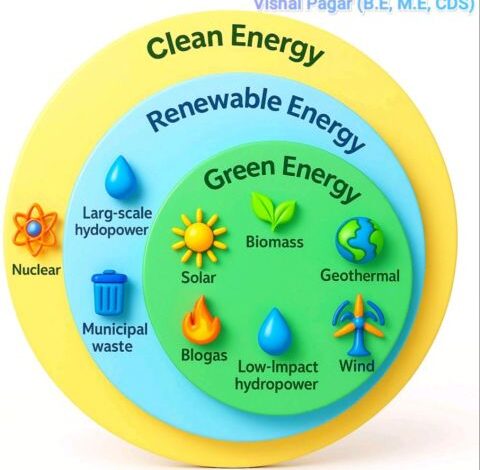
1. Clean Energy
Energy sources that produce little or no greenhouse gas emissions and air pollution during operation.
Examples:
– Nuclear energy
– Large-scale hydropower
– Wind and solar power
2. Renewable Energy
Energy obtained from natural sources that replenish over time.
Examples:
– Solar energy
– Wind energy
– Hydropower
– Geothermal energy
– Biomass and biogas
3. Green Energy
Energy from sources considered environmentally friendly, generally with lower environmental impacts.
Examples:
– Solar power
– Wind power
– Geothermal energy
– Sustainably sourced biomass
– Low-impact hydropower
Here’s the key difference:
– Clean energy focuses on reducing emissions and pollution.
– Renewable energy focuses on naturally replenishing resources.
– Green energy focuses on environmental sustainability.
These categories overlap, but they are not identical.
For example, nuclear energy is generally considered low-carbon and clean during operation, but it is not renewable. Similarly, biomass is renewable when sustainably sourced, but its overall climate impact depends on how it is produced, transported, and used.
Large-scale hydropower can generate low-carbon electricity, yet it may also affect river ecosystems, biodiversity, and local communities.
What does this mean for sustainability professionals?
Choosing an energy source requires looking beyond its label.
A robust assessment should consider:
– Greenhouse gas emissions across the life cycle.
– Land, water, and material requirements.
– Biodiversity and ecosystem impacts.
– Waste generation and end-of-life management.
– Social and economic implications.
This is where Life Cycle Assessment (LCA) becomes valuable. It helps evaluate environmental impacts from resource extraction to production, operation, and end of life.
The goal is not simply to choose an energy source that sounds green. It is to understand its real-world environmental performance and make decisions based on evidence.
Which matters most in your view: low carbon emissions, renewability, or the overall environmental impact across the life cycle?