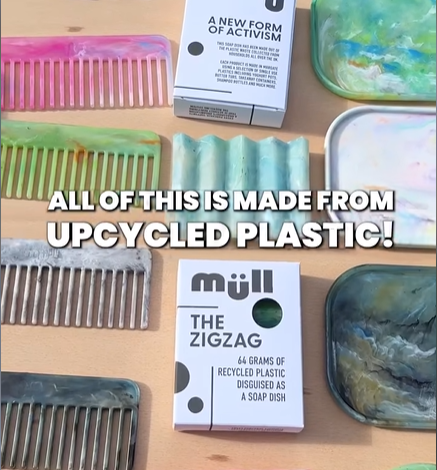
All of this is made from upcycled plastic
How Upcycled Plastic Is Redefining the Future of Design
“The plastic we throw away today could become the furniture we admire tomorrow.”
Walk through your home for a moment. A food container sits in the kitchen. An old DVD case gathers dust on a shelf. Empty contact lens blister packs are tossed into the trash. Thick plastic packaging from online shopping is quickly discarded after opening. To most people, these objects have reached the end of their lives. But what if they haven’t? What if the plastic we consider worthless is actually one of the most underutilized resources in the modern economy? That question lies at the heart of a growing movement transforming waste into products with beauty, purpose, and lasting value.
The Plastic Crisis Is Bigger Than We Think
Plastic has revolutionized modern life. It is lightweight, durable, inexpensive, and remarkably versatile. It protects food, improves healthcare, reduces transportation costs, and enables countless everyday products. Yet these same qualities also make plastic one of the world’s most persistent environmental challenges. Despite decades of recycling campaigns and growing public awareness, only about 9% of all plastic ever produced has been recycled. The majority has ended up in landfills, been incinerated, or leaked into rivers, coastlines, and oceans, where it can remain for hundreds of years. The problem is not simply that we produce too much plastic.
It is that our economy was never designed to keep plastic circulating after its first use. Most products are still created within a linear system: Extract. Manufacture. Consume. Dispose. Once discarded, valuable materials lose their economic value even though their physical properties remain largely intact.
Seeing Waste Through a Different Lens
Upcycling challenges one of our most common assumptions that waste is worthless. Instead of treating discarded plastics as rubbish, upcycling views them as raw materials waiting for their next purpose. Materials that are often difficult to recycle through conventional systems such as DVD cases, cosmetic packaging, contact lens containers, multilayer plastic packaging, or industrial offcuts can be transformed into elegant furniture, decorative panels, lighting, tabletops, home accessories, and architectural elements. What was once destined for landfill becomes a product people are proud to display in their homes. The transformation is more than physical. It changes the story of the material itself.
Circular Design Starts Before Recycling
The most exciting innovation is not always the finished chair, table, or decorative object. It is the system behind it. Imagine a manufacturing process where production scraps are never thrown away but continuously remelted into new products. Imagine factories powered by renewable energy instead of fossil fuels. Imagine existing postal and logistics networks being used to collect plastic waste, reducing transportation emissions by avoiding duplicate delivery systems.
Imagine customers scanning a QR code to trace where the plastic originated, how much waste was diverted from landfill, and how much carbon was avoided through the manufacturing process. This is not simply recycling. It is circular design.
In a circular economy, materials are intentionally kept in use for as long as possible. Products are designed to be durable, repairable, recyclable, and eventually remanufactured into something entirely new. Waste becomes a resource rather than an endpoint.
Why Upcycling Matters
Every kilogram of recycled or upcycled plastic reduces demand for virgin plastic made from fossil fuels. It lowers the need for extracting new raw materials, decreases energy consumption compared with producing new polymers, and helps reduce greenhouse gas emissions across the product lifecycle. Equally important, upcycling creates local economic opportunities. Designers gain access to unconventional materials. Manufacturers develop innovative products with distinctive aesthetics. Communities can build collection networks that create jobs while reducing environmental pollution. Consumers, in turn, purchase products that carry not only practical value but also a meaningful environmental story. A table made from discarded packaging becomes more than furniture. It becomes evidence that waste can be reimagined.
Beauty Can Drive Sustainability
One of the greatest barriers to circularity has never been technology. It has been perception. For many years, products made from recycled materials were often associated with lower quality or limited design appeal. Today, that perception is changing. Architects, designers, and manufacturers are demonstrating that upcycled materials can be modern, elegant, durable, and desirable. Rather than hiding their recycled origins, many products celebrate unique colors, textures, and patterns created by mixed plastic streams. In doing so, they transform environmental responsibility into a design feature rather than a compromise. When sustainable products are also beautiful, circularity becomes easier for people to embrace.
The Future of Plastic Is Not Disposable
Plastic itself is not the enemy. The real problem is treating a material designed to last for centuries as though it should be used for only a few minutes. The future of plastics will not be defined solely by better recycling technologies.It will depend on smarter product design, local innovation, circular manufacturing, extended producer responsibility, and business models that reward keeping materials in circulation rather than constantly extracting new resources. Every product should be designed with its next life already in mind.
From Pollution to Possibility
Imagine if every discarded plastic item were viewed not as waste, but as valuable material waiting for its next purpose.
source: