Climate action : mitigation vs adaptation
Climate Action Requires Two Complementary Strategies: Mitigation and Adaptation
Climate change is no longer a distant threat discussed only in scientific reports or international conferences. Its impacts are already being felt across the globe through rising temperatures, stronger storms, prolonged droughts, devastating floods, sea level rise, and more frequent wildfires. These events are disrupting economies, damaging ecosystems, threatening food and water security, and affecting the health and livelihoods of millions of people.
The question today is no longer whether climate action is necessary—it is how the world can respond effectively.
The answer lies in pursuing both climate mitigation and climate adaptation. While these two approaches serve different purposes, they are equally essential and mutually reinforcing. A resilient and sustainable future cannot be achieved without investing in both.
Climate Mitigation: Addressing the Root Cause
Climate mitigation focuses on reducing the greenhouse gas emissions that drive global warming. Its primary objective is to limit the magnitude of future climate change by addressing its underlying causes.
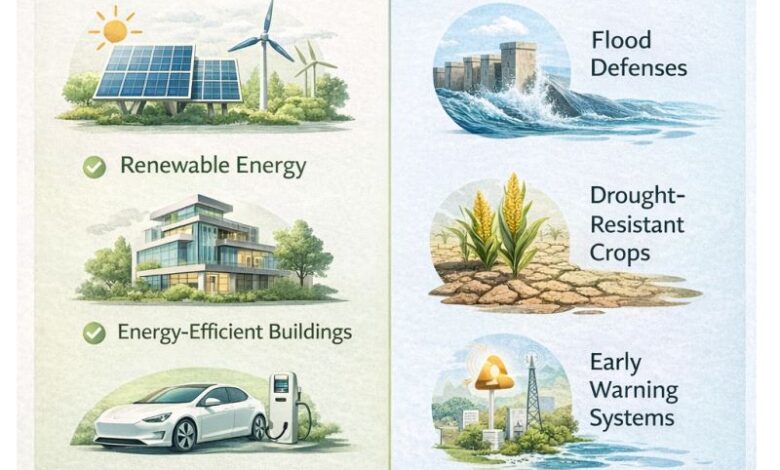
Mitigation efforts include transitioning from fossil fuels to renewable energy sources such as solar, wind, and hydropower; improving energy efficiency in buildings and industries; electrifying transportation; promoting sustainable land use; protecting forests and mangroves; and adopting low-carbon technologies across economic sectors.
These actions not only help reduce carbon emissions but also deliver additional benefits, including cleaner air, improved public health, greater energy security, technological innovation, and new economic opportunities through the growth of green industries.
By limiting future warming, mitigation reduces the severity and frequency of long-term climate risks, making communities more resilient in the decades ahead.
Climate Adaptation: Preparing for Today’s Reality
While mitigation aims to prevent future climate change, adaptation addresses the impacts that are already unavoidable.
Even if global emissions were reduced dramatically today, the climate system would continue to respond to past emissions for many years. As a result, communities must prepare for increasingly frequent and intense climate-related hazards.
Climate adaptation involves strengthening society’s ability to anticipate, withstand, and recover from these impacts. Examples include constructing flood defenses and coastal protection systems, restoring wetlands and mangroves, developing drought-resistant crops, improving water management, expanding early warning systems for extreme weather, designing climate-resilient infrastructure, and updating urban planning to account for changing climate conditions.
Adaptation also requires investing in education, healthcare, disaster preparedness, insurance mechanisms, and social protection programs that help vulnerable populations cope with climate-related shocks.
Rather than preventing climate change itself, adaptation reduces the human, economic, and environmental costs associated with its consequences.
Two Strategies with One Shared Goal
Mitigation and adaptation are sometimes presented as competing priorities, particularly when governments and organizations face limited financial resources. In reality, they are complementary strategies that address different dimensions of the same global challenge.
Mitigation determines the climate future we will experience.
Adaptation determines how well society can cope with the climate changes already underway.
One strategy cannot replace the other.
If countries focus only on mitigation, communities will remain exposed to current and worsening climate risks for decades before emission reductions produce their full effect. Conversely, if adaptation becomes the sole priority while emissions continue to rise, climate impacts will intensify beyond the capacity of many communities and ecosystems to adapt.
The most effective climate policies therefore integrate both approaches into a unified long-term strategy.
A Shared Responsibility Across Society
Addressing climate change requires coordinated action from every sector of society.
Governments play a critical role by establishing climate policies, investing in resilient infrastructure, enforcing environmental regulations, and supporting research and innovation.
Businesses can accelerate the transition by reducing operational emissions, adopting clean technologies, improving supply chain resilience, and integrating climate risks into corporate decision-making.
Financial institutions and investors can direct capital toward renewable energy, sustainable agriculture, resilient infrastructure, and nature-based solutions while reducing investments in high-emission activities.
Communities, researchers, civil society organizations, and individuals also contribute by promoting sustainable lifestyles, protecting local ecosystems, supporting climate education, and participating in adaptation initiatives that strengthen local resilience.
International cooperation remains equally important, as climate change is a global challenge that transcends national borders and requires shared knowledge, technology transfer, and climate finance.
Investing in Resilience for Future Generations
Climate action should not be viewed solely as an environmental obligation. It is also an investment in economic stability, public health, food security, biodiversity conservation, and long-term prosperity.
Every dollar invested in reducing emissions helps lower future climate risks, while every investment in adaptation reduces the economic and human costs of climate disasters that are already occurring.
As climate impacts continue to intensify, the need for integrated action becomes increasingly urgent. Delaying mitigation will increase future adaptation costs, while neglecting adaptation will expose communities to avoidable losses and suffering.
The world’s most effective climate strategy is not choosing between mitigation and adaptation it is recognizing that both are indispensable.
Mitigation addresses the causes of climate change by reducing greenhouse gas emissions and limiting future warming. Adaptation addresses its consequences by strengthening the resilience of people, infrastructure, ecosystems, and economies against unavoidable climate impacts.
Together, these strategies provide the foundation for a safer, more sustainable, and climate-resilient future.
The future will not be secured by reacting to climate change alone. It will be built through decisive action that simultaneously reduces its causes, prepares for its impacts, and ensures that societies are equipped to thrive in a changing climate.