
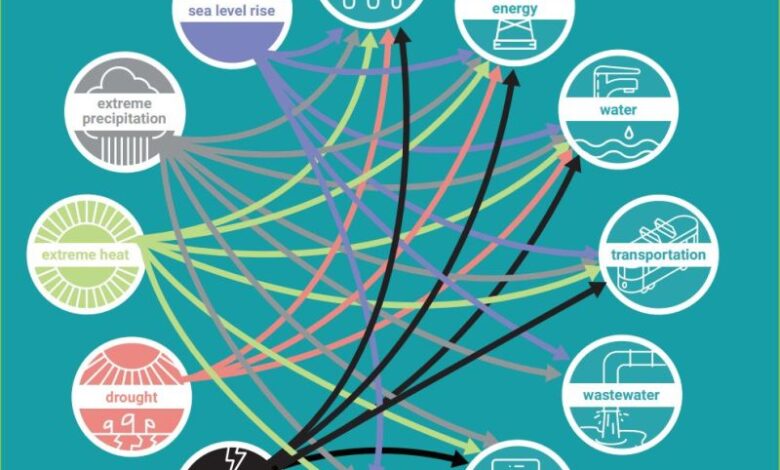
Climate hazard impacts on sectors
The Great Domino Effect: Why Climate Resilience Is the New Foundation of Civilization
Climate change has officially graduated from an “environmental concern” to a systemic threat. It is a silent force re-engineering the DNA of our cities, our markets, and our daily survival.
The reality we face is not a series of unfortunate weather events, but a cascading failure of interconnected systems. When one pillar of our modern infrastructure buckles under climate stress, the entire architecture of society feels the vibration.
The Cascade: How Hazards Ripple Through Life
Climate hazards do not operate in silos; they act as “threat multipliers” that trigger chain reactions across every sector we rely on:
- Sea-Level Rise: It does more than swallow coastlines. It infiltrates groundwater, corrodes energy substations, and severs the global maritime supply chains that put food on our tables.
- Extreme Heat: This is an invisible tax on infrastructure. It sags power lines, buckles railway tracks, and creates a “thermal spike” in energy demand that can lead to total grid collapse.
- Intense Precipitation: When the sky opens, it’s not just about flooding. It’s about wastewater systems back-flowing into streets, telecommunications towers losing structural integrity, and the physical isolation of communities as roads wash away.
- Drought & Wildfire: These are the twin thieves of security. Drought starves hydro-electric dams and agriculture, while wildfires incinerate the energy grids and fiber-optic networks that keep the world connected.
The Interdependency Trap
The modern world is a masterpiece of efficiency, but a nightmare of fragility. We have built our systems like a house of cards:
- Energy failure instantly paralyzes Water and Telecom.
- Transport disruption halts Waste Management and Emergency Response.
- Communication blackouts render Food Logistics impossible.
Our current “siloed” planning where the energy department doesn’t talk to the water board is no longer just inefficient; it is dangerous.
The New Mandate: System-Wide Resilience
The era of sector-by-sector adaptation is over. To survive a warming world, cities, investors, and policymakers must pivot toward a holistic resilience framework:
- Integrated Risk Assessments: Moving beyond “will it flood?” to “if it floods, how does our hospital stay powered and our food stay refrigerated?”
- Cross-Sector Adaptation: Designing infrastructure that serves multiple purposes (e.g., parks that act as flood basins and cool the city).
- Foundational Resilience: Recognizing that climate action isn’t just about “saving trees” it’s about safeguarding the invisible systems that keep society civil.
In the 21st century, resilience is not a line item in a budget. It is the foundation upon which all economic and social stability is built.
source:


