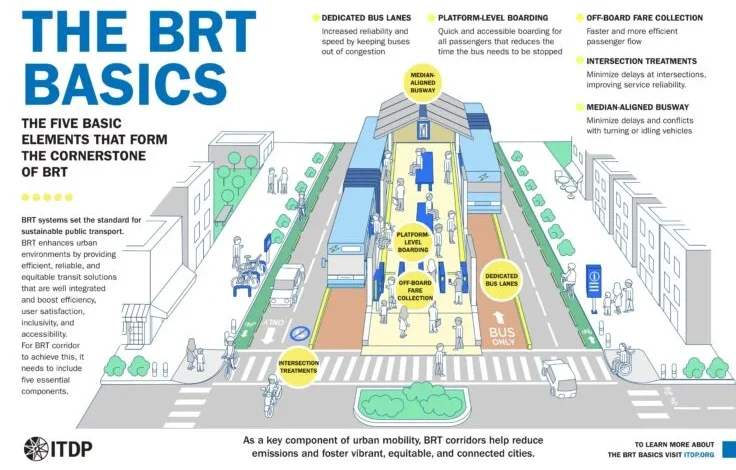
Deep dive into BRT on ITDP’s learning hub
In the bustling heart of Dakar, where traffic snarls have long been a daily frustration and public transport was once synonymous with aging, informal minibuses, a quiet revolution is unfolding one powered by solar energy and propelled by the aspirations of a city reinventing itself. Dakar’s Bus Rapid Transit (BRT) system is more than just a transportation upgrade. It’s a symbol of transformation. Designed to carry 300,000 people every day, it slashes commute times from an arduous 95 minutes to just 45. For workers, students, caregivers for anyone who relies on public transport that’s not just convenience; that’s time reclaimed for living.
At the core of this revolution is a fleet of 144 fully electric articulated buses, gliding through the city on dedicated lanes. With a battery capacity of 560 kWh, they quietly traverse Dakar’s corridors, powered by solar-generated renewable energy a bold commitment to a zero-emissions future for African cities. These buses don’t just reduce air pollution and climate emissions they elevate the standard for what African cities can and should offer their people. But Dakar’s BRT isn’t just about getting from A to B. It’s about how we get there and who gets to ride.
The system’s design is inclusive by intent. From level boarding platforms and well-lit pedestrian crossings to cycle tracks and accessible buses, every detail has been considered to serve all users women traveling at night, children walking to school, people with disabilities navigating the urban landscape. In a city where walking is a primary mode for many, these features aren’t luxuries. They are necessities, and they represent a new standard of dignity and safety.
This ambition didn’t appear overnight. Dakar’s journey to modern transit has been a decades-long response to a deeply informal system. With support from institutions like CETUD, the World Bank, and ITDP, Dakar began the process of renewal in the early 2000s. Informal operators, once the city’s only option, were invited to form cooperatives, take ownership of new fleets, and enter a regulated system where reliability and safety were prioritized.
That first step formalizing the informal laid the groundwork for something bigger. Dakar’s leadership saw the success of systems like Bogotá’s Trans Milenio and began imagining what a Senegalese version could look like. Guided by feasibility studies, design workshops, and technical support from ITDP and USAID, the city mapped its future one where people, not just vehicles, came first.
And so, the BRT came to life. Trunk and feeder routes optimize coverage and efficiency. Smart charging aligns with real-time demand. Integration with the regional rail system makes multi-modal travel seamless. And a private-public financing model led by Dakar Mobilité, with investment from Meridiam and Senegal’s own FONSIS ensures long-term viability. A minimum passenger guarantee of 100,000 riders per day and a fare structure based on affordability safeguard the system’s financial health without sacrificing equity.
Importantly, inclusivity doesn’t stop at the station platform. Out of 1,000 jobs created through the BRT, 35% are being reserved for women a direct challenge to gender stereotypes in transport. One of the new system’s early female bus drivers is already paving the way. Gender-based violence prevention systems are being embedded from the start not as an afterthought, but as a core operating principle.
And for the 17% of riders from low-income and marginalized groups, the system offers a 50% fare reduction a policy backed by government subsidies to ensure mobility is a right, not a privilege. This is the power of thoughtful urban transport: not just to move people, but to move societies forward.
To ensure others can follow in Dakar’s footsteps, ITDP has curated a BRT Resource Hub a self-guided learning platform built on years of global experience. Organized in four modules, the Hub offers everything from policy guidance and design templates to real-world case studies and technical specifications. Whether you’re a city planner in Lagos, a civil society advocate in Nairobi, or a student in Cape Town, the Hub provides a pathway to plan, design, and advocate for world-class BRT systems. And for those who want to showcase their learning, there’s even a certificate to validate their expertise.
In many ways, Dakar’s BRT system is a promise: that African cities can lead in sustainable, inclusive mobility. That public transport can be dignified, beautiful, safe, and green. That even amid historic challenges, cities can choose to transform. And Dakar has made that choice not just for itself, but as a signal to the continent and the world.
source:
https://itdp.org/2025/02/04/deep-dive-into-brt-on-the-itdp-learning-hub/