European scholarships
European Higher Education Guide: Fully Funded Scholarships Without IELTS
Studying in Europe offers world-class academic standards, rich cultural immersion, and strong career pathways. A common misconception among international applicants is that an IELTS score is universally mandatory for admission and financial aid.
In reality, numerous national governments and academic institutions across 14 European nations accept alternative English Proficiency Proof (EPP) such as a Medium of Instruction (MOI) certificate from your previous university, Duolingo English Tests, or direct institutional interviews.
This strategic guide outlines the scholarship landscape, alternative language requirements, and a step-by-step application blueprint across top European destinations for Bachelor’s, Master’s, and PhD programs.
Alternative Ways to Prove English Proficiency Without IELTS
If a university or scholarship program lists IELTS as optional or flexible, you can typically satisfy the language requirement through one of the following pathways:
Geographic Breakdown: 14 European Nations Offering Flexible Mobility
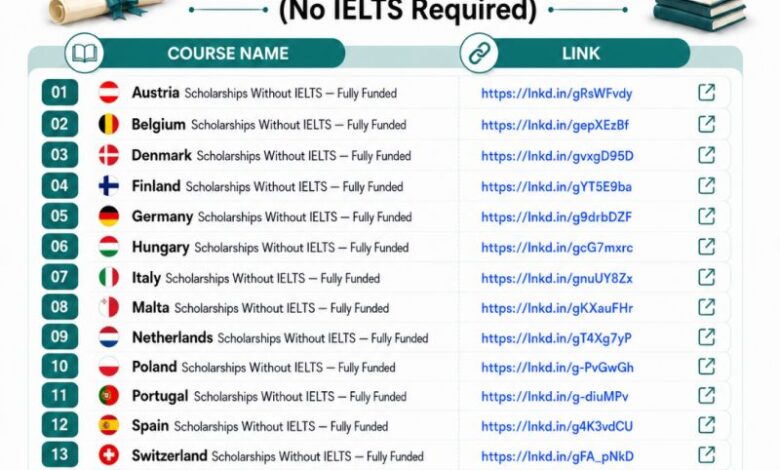
The following matrix highlights the key government and institutional scholarship frameworks across 14 top European study destinations:
| Country | Primary Flagship Funding Frameworks | Alternative Language Proof Accepted? |
| Germany | DAAD Scholarships, Deutschlandstipendium | Yes (MOI letter accepted by many universities) |
| Hungary | Stipendium Hungaricum | Yes (Institutional oral/written entrance exams) |
| Italy | DSU Regional Grants, MAECI Italian Govt Scholarships | Yes (MOI letter or prior English-taught degree) |
| Austria | OeAD Grants, Austrian Development Cooperation | Yes (MOI letter evaluated per department) |
| Netherlands | NL Scholarship (formerly Holland Scholarship), OKP | Yes (Varies by university; MOI or DET often valid) |
| Finland | Finnish Government / University Tuition Waiver Waivers | Yes (Previous degree in English in EU/EEA/specified countries) |
| Sweden | Swedish Institute (SI) Scholarships | Yes (Degree taught in English meeting Swedish Council requirements) |
| Belgium | VLIR-UOS, Master Mind Scholarships | Yes (MOI certificate accepted by select Flemish/French universities) |
| Denmark | Danish Government Scholarships for non-EU/EEA | Yes (Prior English education verification) |
| Poland | Banach Scholarship, Łukasiewicz Scholarship | Yes (MOI letter or Polish embassy confirmation) |
| Portugal | Camões Scholarships, FCT PhD Fellowships | Yes (University interview or MOI certificate) |
| Spain | MAECED / Carolina Foundation / Severo Ochoa Grants | Yes (MOI or Spanish/English dual proficiency options) |
| Switzerland | Swiss Government Excellence Scholarships, ETH/EPFL Grants | Yes (Departmental review / MOI verification) |
| Malta | ENDEAVOUR II, University of Malta Waiver Schemes | Yes (MOI letter standard for native/English-stream institutions) |
What Fully Funded Scholarships Typically Cover
Winning a fully funded award significantly reduces or eliminates the financial burden of studying abroad:
Step-by-Step Application Blueprint
To maximize your chances of securing a fully funded award without IELTS, follow this structured roadmap:
1.Step 1: Secure Your Medium of Instruction (MOI) Certificate:Action Plan.
- Request an official, signed, and stamped Medium of Instruction (MOI) letter from your undergraduate or secondary institution registrar.
- Ensure the document explicitly states: “All courses, examinations, and thesis defenses were conducted entirely in the English language.”
2.Step 2: Map Universities Accepting Alternative Proof:Action Plan.
- Filter university admission portals across target countries (e.g., DAAD portal for Germany, Universitaly for Italy, Stipendium Hungaricum portal for Hungary).
- Verify departmental language requirements under “Admission Criteria” to ensure MOI or Duolingo is explicitly permitted.
3.Step 3: Prepare Core Application Documents:Action Plan.
- Curriculum Vitae (Europass Format): Standardize your academic and professional history according to European guidelines.
- Statement of Purpose (SOP) / Motivation Letter: Clearly articulate your academic trajectory, career objectives, and why you selected the specific European institution.
- Recommendation Letters (2-3): Obtain academic references highlighting your research capability and English fluency.
4.Step 4: Submit Institutional & Scholarship Applications:Action Plan.
- Submit university admission applications before scholarship deadlines (many national scholarships require pre-admission or joint submission).
- Prepare for prospective online faculty interviews to demonstrate spoken English fluency directly.
Critical Advisory Before Applying
Always verify the specific language requirements on the official university department web page before submitting your application. While national scholarship schemes may allow flexible language proof, individual faculty departments reserve the right to set specific English proficiency standards.
source: