
Extended Producer Responsibility (EPR)
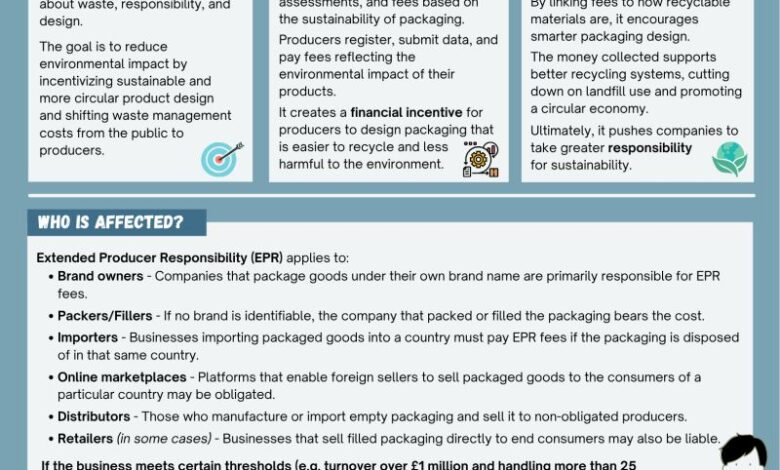
Extended Producer Responsibility (EPR) is a policy that shifts the financial and physical responsibility for a product’s entire lifecycle especially its disposal from the public to the producers. This includes anyone who designs, manufactures, imports, or sells packaged goods. Instead of taxpayers and local authorities footing the bill for waste management, the companies that create the waste are now held accountable.
The “Polluter Pays” Principle in Action
EPR operates on a simple yet powerful concept: the “polluter pays” principle. This means that the entities who profit from putting products on the market must also bear the costs of managing the environmental impact of their packaging. These entities typically include brand owners, packers, importers, and even online marketplaces and distributors.
Under an EPR framework, these businesses are responsible for covering the costs of:
- Collection and Recycling: Funding systems to collect and recycle their packaging waste.
- Public Awareness: Supporting campaigns to educate consumers on proper waste sorting and recycling.
- Data Reporting: Managing compliance and reporting data on the amount and type of packaging they produce.
- Eco-modulation Fees: In some regions, producers are charged variable fees based on their packaging. For example, a company using easily recyclable materials might pay a lower fee, while one using difficult-to-recycle materials would pay a higher one.
Driving a Circular Mindset
EPR is more than just a fee; it’s a paradigm shift that encourages a circular economy. It incentivizes producers to rethink their packaging from the very beginning. By linking the cost of disposal directly to the design of the product, EPR drives a shift toward more sustainable practices.
This new accountability has a ripple effect:
- Drives Better Design: Producers are motivated to prioritize minimalist, reusable, and easily recyclable packaging to lower their costs.
- Embeds Lifecycle Thinking: It forces companies to consider the full “cradle-to-grave” environmental impact of their products, not just the point of sale.
- Unlocks Innovation: By creating a clear financial incentive, EPR encourages the development of new, smarter systems, from compostable materials to more efficient reverse logistics.
Ultimately, EPR provides a blueprint for a future where sustainability isn’t an afterthought but a core part of the design process.
source:


